Maledetto il giorno che t’ho abitata


Mi sono trasferita a Milano il 13 gennaio 2020. Ancora non si parlava del virus, eppure in quei giorni il Covid-19 stava già cominciando a diffondersi in Lombardia. Forse aveva viaggiato a bordo di un treno, come me. Forse si era disperso tra gli ampi corridoi della Stazione Centrale, aggrappandosi stretto allo zaino di qualcuno diretto altrove.

Forse, invece, aveva preso un taxi per il centro di Milano e chissà se anche a lui era capitato il tassista che ce l’aveva a morte con Beppe Sala per i lavori della nuova linea della metropolitana, la M4. «Invece di fare tutto questo casino, bastava aggiungere qualche fermata in più alla linea gialla ed era fatta. Tutto questo rumore e poi lo sa quanti soldi pubblici…. Fino al 2021 questo casino eh».

Quello che più ho amato della sistemazione che sono riuscita a trovare, dopo mesi passati a iscrivermi ai siti di affitti più disparati e disperati, è la posizione. Si trova a pochi passi dalle colonne di San Lorenzo, noto come uno dei luoghi più vivaci della movida milanese. Quel posto ha un significato particolare per me. Nell’incrocio tra Corso di Porta Ticinese e via Molino delle Armi c’è Farini, il locale dove feci il mio primo aperitivo milanese quasi due anni fa. Allora non sapevo che un giorno mi sarei trasferita proprio qui e a dir la verità ritenevo Milano piuttosto scialba. Eppure, in quel luogo e in quel preciso momento, mi resi conto di essere felice dopo tanto tempo. Roma, la mia bella Roma, non era stata in grado di mettermi dinanzi a questa consapevolezza. 

È un po’ come quando ci si sente più capiti da uno sconosciuto piuttosto che dall’amico di una vita.

Questa zona, oltretutto, mi rievoca uno dei miei film preferiti di Carlo Verdone, Maledetto il giorno che t’ho incontrato (1992). Nel film Margherita Buy abita proprio in un appartamento vicino al colonnato, ripreso in molte scene. Direi che il rapporto nevrotico tra i due protagonisti, Bernardo e Camilla, rispecchia a pieno quello tra me e Milano.

Scena tratta dal film Maledetto il giorno che t’ho incontrato

Non la sopporto ma, allo stesso tempo, mi fa divertire come poche altre città.

In alcuni periodi ho bisogno di starle lontana, ma, anche se non voglio ammetterlo, me ne scopro innamorata. Di fronte a Farini c’è la libreria Verso, una delle più attive d’Italia. Organizzano eventi, presentazioni e fanno discreti aperitivi. Il giorno di San Valentino c’era una presentazione a cui avrebbe partecipato Marco Missiroli, anche lui un milanese d’adozione, di cui avevo iniziato a leggere Atti osceni in luogo privato. È un romanzo ambientato in parte a Milano e il fatto che conoscessi quasi tutte le vie indicate mi dava l’impressione di essere parte di questa città. In realtà quella sera alla fine decisi di andare a fare un aperitivo al Tongs, sui Navigli, con i miei amici. Era la prima serata tutti insieme nel ritrovo più alla moda di Milano e sarebbe stata anche la nostra ultima uscita spensierata.

Alla fine tornai a casa prima degli altri perché mi sentivo stanca. Per questo, quella sera si è aggiudicata un posto d’onore nella mia lista dei rammarichi insieme a tutte le cose che non ho fatto, non ho detto, non ho vissuto al massimo prima del virus. Mentre scrivo provo sensazioni strane. Mi sembra di riferirmi alla vita di qualcun altro e di scrivere guardando dall’alto, come un narratore onnisciente.

La pandemia che stiamo vivendo ha segnato uno spartiacque tra il prima e il dopo, creando una voragine tra questi due spazi temporali. È difficile parlare di qualcosa ancora in evoluzione ma ci proverò. All’inizio la trasformazione accaduta alla città era la cosa che più mi angosciava. So che non è niente a confronto dell’inferno accaduto negli ospedali e nelle case di molti. Eppure, proprio quel silenzio urlante mi parlava più di qualsiasi bollettino delle 18.

Affacciarmi e vedere le colonne deserte, non sentire le voci, non vedere più le persone indaffarate nella loro quotidianità. Impensabile per qualsiasi città, ma per Milano soprattutto.
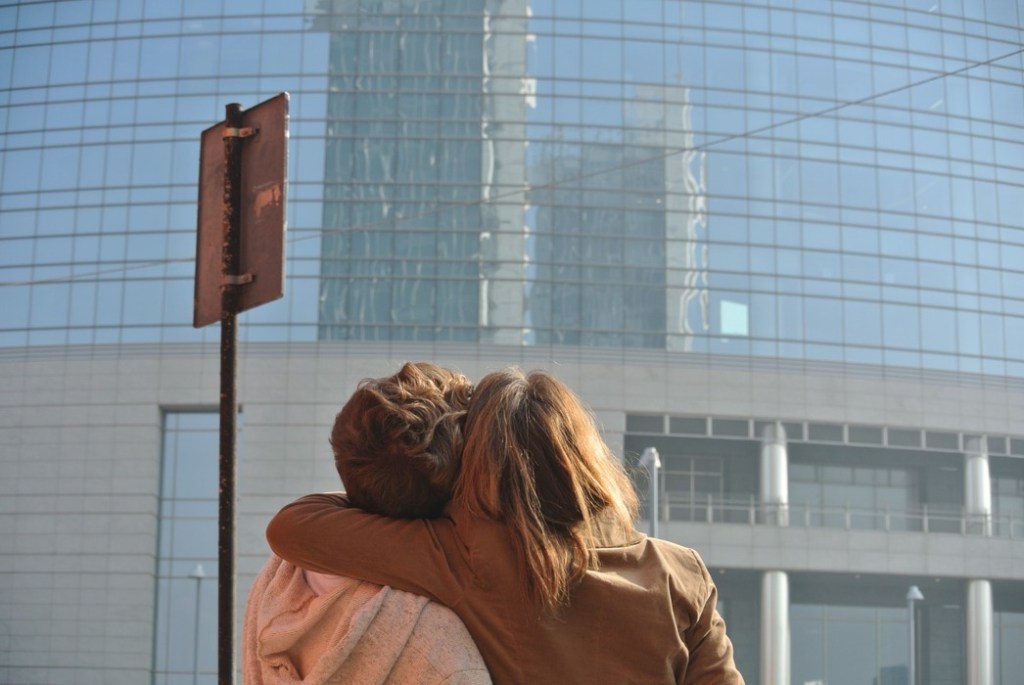
Foto di Ilaria Palmieri

Non è necessario vivere qui per sapere cosa Milano sia diventata negli ultimi anni. Se Roma rimane il luogo dell’ispirazione per eccellenza, è Milano il dove da cui tutto ha inizio.

È il motore, la fucina, il laboratorio. La velocità inarrestabile, il senza limiti, il pragmatismo. Non è più una città italiana come le altre, è diventata la città.

Ormai da molti anni assisto all’emigrazione sempre più massiccia di giovani neolaureati a Milano. Per la mia generazione, mai così qualificata eppure penalizzata dalla mancanza di prospettive, questa città è rimasta l’unica alternativa alla difficile decisione di abbandonare l’Italia.

Ripeto: non pensate che il mio rapporto con Milano sia così pacifico. Ho passato momenti in cui non sopportavo più di essere confinata in un posto che in fondo non mi appartiene, in cui ho giurato di non tornarci mai più, arrivando a colpevolizzarlo di essere uno degli epicentri di questa tragedia. 

Tuttavia, la parola Milano mi rievoca tante altre cose che non posso dimenticare.

Quella sera di fine gennaio in cui andai alla Feltrinelli di piazza Piemonte per la presentazione del libro di Claudio Martelli su Craxi (qualche giorno dopo avrei visto Hammamet nel cinema di viale Tunisia, in una sala gremita di persone interessate alla storia di uno dei milanesi più famosi della storia italiana). Ero arrivata molto in anticipo per prendere il posto e un uomo elegante sulla settantina, seduto accanto a me, cominciò ad attaccare bottone.

Era simpaticissimo e per questo mi ricordava tanto mio nonno. Passai l’ora di attesa ad ascoltarlo raccontarmi la sua vita. Aveva frequentato lo stesso liceo di Martelli, vissuto la Milano da bere, era diventato un imprenditore affermato, si era innamorato di una donna (romana) quando era già sposato. Nel frattempo, arrivarono anche il sindaco Beppe Sala e Luciano Fontana. Ad un certo punto, l’uomo seduto davanti a me si accasciò a causa di un collasso e fummo noi due, imprevedibili protagonisti del momento, ad intervenire per tirarlo su mentre i relatori guardavano la scena basiti e chiamavano l’ambulanza. Alla fine di tutto, ci scambiammo un “buona fortuna” con quella particolare nostalgia che si prova per tutto ciò che è finito troppo presto.

Quella mattina che ricevetti su Instagram il messaggio da una signora che aveva trovato la mia tessera Atm per strada. La sera prima ero tornata brilla e felice da una serata in enoteca con Miriam, e probabilmente mi era caduta all’uscita della metro. Già mi tormentava il pensiero della lunga fila all’ufficio in piazza Duomo per rifare l’abbonamento, mentre qualcuno girava indisturbato utilizzando la mia carta. Invece, la signora me la fece ritrovare in un bar di Corso Italia all’interno di una busta bianca con scritto “Per Francesca”.

Quella sera che mi feci tre ore di fila fuori dal Piccolo Teatro per assistere allo spettacolo di Daniel Pennac sul suo libro La legge del sognatore ispirato a Federico Fellini. All’inizio eravamo solo una ventina, poi cominciammo ad aumentare a dismisura. Era la prima tappa del tour dello scrittore francese, realizzato per omaggiare il rapporto tra Fellini e i sogni. Era stata scelta proprio Milano per questo debutto importante. Pennac iniziò lo spettacolo, ricreando sulla scena un suo sogno infantile: la lampada del suo comodino comincia a colare. La luce diventa liquido inarrestabile e arriva a riempire tutta la sua stanza, addirittura finisce per inondare la città intera come uno tsunami irradiante.

Se mi chiedete come immagino la fine di tutta questa storia, vi rispondo così: come una luce rigenerante che seppellisce tutto e ci dà la possibilità di ricominciare daccapo. Spesso mi domando se, in questi eventi raccontati, il dannato virus si trovasse lì con me. Sulle mani di qualche signore seduto ad ascoltare Martelli, sulla mia tessera ATM, volando liberamente tra le parole di Pennac. Forse sì. Forse no.

Forse è sempre la stessa storia: in ogni esplosione di vita c’è anche un po’ di morte. 

Ancora una volta Milano mi ha fatto capire qualcosa che in realtà sapevo già.
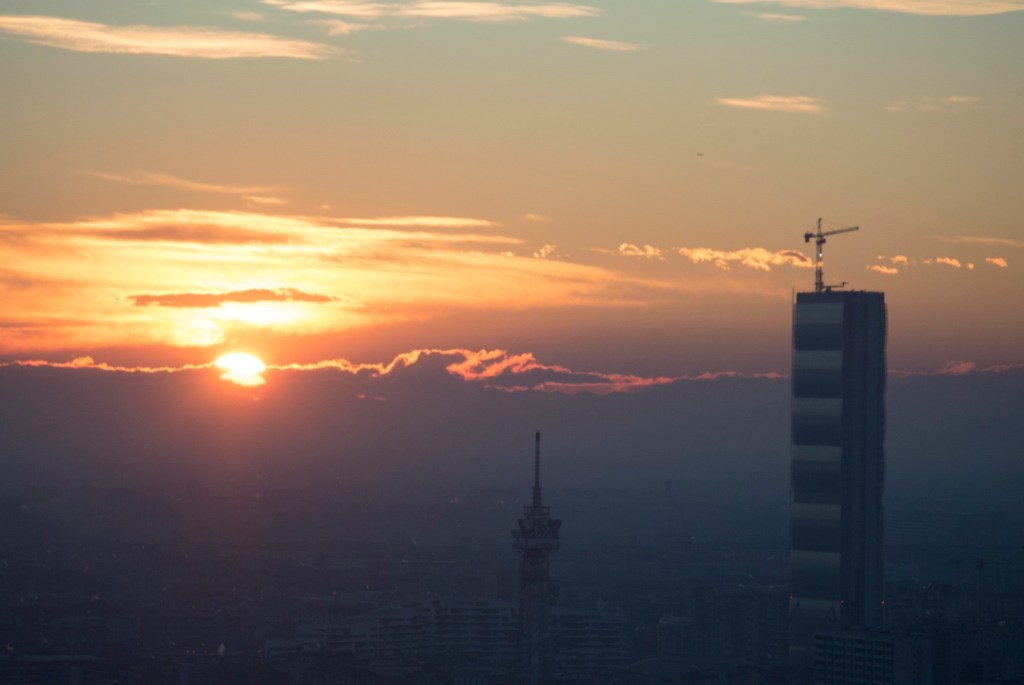
Foto di Ilaria Palmieri

di Francesca Scerrato

New York: the Big Apple half bitten

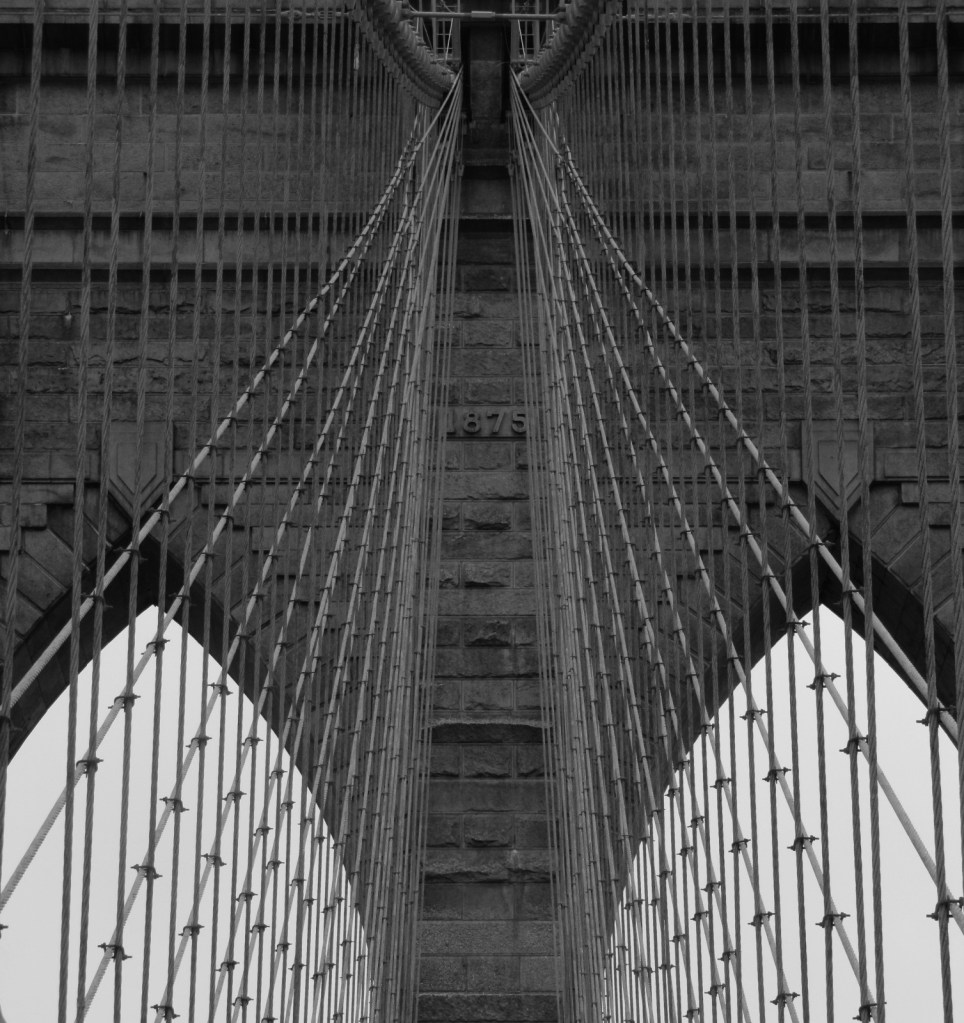
A black and white photo, which shows many cars in the queue, taken by a father who, in this long period of quarantine, plays with his son. Here, if we change our point of view even a little, we see a daily scene of a busy and chaotic New York street, where the gray turns yellow and black, enlightened by the colors of the neon.

A month after my premature departure from New York, fleeing the incipient epidemic of Covid-19, the sad end of my American dream, it is natural to wonder about the matter, trying to find some answers to make sense of this quarantine full of “What ifs…”.

I am certainly not the only one to have lived surreal days, torn between fear and the desire to stay,  therefore I will spare you the details. The only thing I want and I can remember is my disbelief in packing those bags, in an afternoon spent peeling off posters and putting aside clothes and ambitions that have never been achieved.

Today, a month later, I wonder why I didn’t visit the Guggenheim before leaving. Then I try to remember what my subway line was, how it felt to walk in Central Park, and why I strongly wanted to go to New York and then everything seems like a fuzzy memory as in a restless dream. Today, confined within the walls of my room, I even begin to doubt if I’ve ever really been to New York.

Foto di Jacopo Priori

In these two months, I have probably experienced only the first phase of life in New York, the most difficult and most exciting one, when you still have to find your place in a society that they have described to you as legendary. Of the Big Apple is usually said: if you are not in New York you are nowhere. Here, I was in New York but I swear to you that at least the first month I felt “nowhere”. In an attempt to build a semblance of everyday life, I inevitably lived as the last arrived, wandering in a city without being able to really grasp it, without being able to look it in the eye.

This is because New York is more fragile than we expect, it is a great social experiment never seen before, a complex gear where dozens of nationalities and cultures often coexist in harmony and disagreement. If Paris and London are the symbols of the new cosmopolitan center, America and her New York are its sublimation.

Questions, contradictions are now the priority of New York and its cultural institutions. Who devised New York? Who lives it today? Who made New York the capital of the western world?

A photo by Jacopo Priori

In fact, the different “New Yorks” known so far are many. There is the New York of fashion, the one of Sex and the City, the one of rich people, the one of poor people, the one of those who do not even speak English. There is the New York of art galleries and the New York of avant-garde architecture. And then there is the New York of great museums, those full of European masterpieces, those of patrons and “concerts in the galleries”, those that organize more cocktail parties than exhibitions, where each conference has a cost to empty the pockets of any student.

Right there, next to European masterpieces, there is the New York of history and cultural museums, which may seem negligible to many, considered the museums to be visited “if I have time left”. Beware of such advice from tour operators, because it is these institutions that allow the city today to build a new sense of community, forging aware citizens rather than just intellectuals.

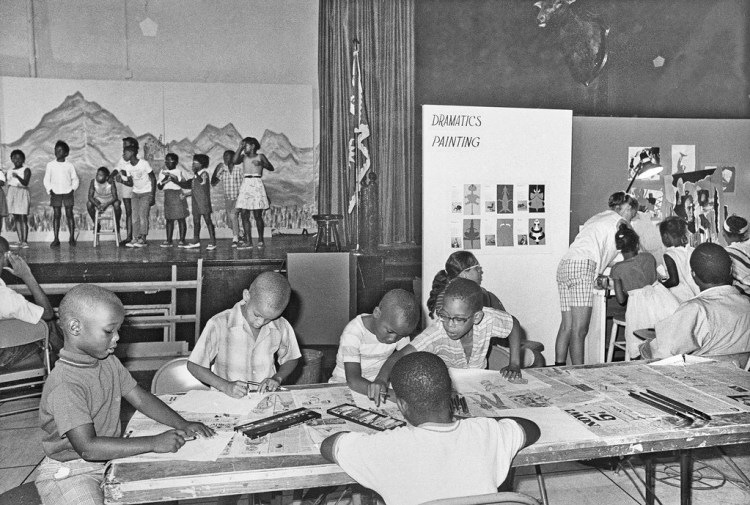
It all began with the great experiment of the Anacostia Museum, the result of one of the meetings of the American Association of Museums and established in 1967 in a converted cinema in southeastern Washington DC, as the first neighborhood museum. It is part of the Smithsonian cultural institution, the same organization that at the time wondered how to bring the Latin and Afro-American communities of the suburbs into museums. These communities were often very poor, but the reason for their poor cultural involvement did not depend on the ticket price. In fact, the new visitors had to make long journeys by public transportation in order to reach the city center. And once they arrived at the museum, they would find a cultural heritage insignificant to them, one in which it would have been difficult to identify. At the time, the only artistic and cultural movements presented in the great museums were just European or anyway western, acquisitions that were often illegitimate or inconsistent with the stories of the cities in which they were preserved. Little was the space dedicated to the Orient or the African arts.

Anacostia Museum, 1970

Dillon Ripley of the Smithsonian, therefore, decided to found a museum right in the heart of the suburb of Anacostia, to create an active cultural point of reference in a territory in which citizens could identify. The museum had a very simple collection, it was mostly travelling exhibitions on cardboard panels, but its strength laid in its activities. Over time, the museum became a true meeting point for the community, with exhibitions focused on the history of the Anacostia district.

The inhabitants themselves were called to make their contribution. A special committee was created, called the Neighborhood Advisory Committee, composed mainly of very young citizens, the Youth Advisory Council, who collaborate with the curators for conceiving  programs and exhibitions.

Projections, debates, concerts and lessons open to all were organized. “This thing called Jazz”, or “The Rat: Man’s invited afflictions” are just some of the virtuous examples of the Anacostia Museum. Problems such as violence, crime, inequalities and drugs are fundamental in the narrative of the neighborhood museum. Besides, the museum became a privileged observation point for institutions to understand the features of the community and to solve its problems. A documentation center was founded, and the museum became soon a meeting place. Today, the case of Anacostia turns out to be a successful model that follows the principles of the movement of the French Nouvelle Muséologie. The museum transforms the visitor into an active protagonist.

Like the Anacostia Museum, today the Museum of the City of New York, founded in 1923, tries to make some order, to give meaning to the stories of its communities, to explain them, to tell them. The themes covered by the museum range from baseball history to the Stonewall affair, until the exhibition Who We Are: Visualizing NYC by the Numbers, an anticipation of the 2020 census, which highlights the importance of the so-called “data” to study the demographic profile and social life of the city.

Needless to say, the museum raises interesting questions, such as the facts of the Activist New York section, which deals with the history of the social struggles that have marked the city, questions that tourists would never have expected to find in the rooms of a museum.

Established with the principle of “first the visitor, then the work of art”, perhaps American museums understood immediately that they had to know how to talk to their public, respecting the mission, with which the museums are invested, to reflect on today’s society, to become the social vector of a complex cultural system, torn between emancipation and inequality, and to represent a model for a world without wars.

For this reason, New York is for many a dream with the traits of the cruellest truth. We are looking for Scorsese’s, Woody Allen’s New York, but we soon realize that, after all, the only New York we can live is “our New York”, and we are inexorably disappointed. Forced into a daily life that leaves little room for imagination, we realize that perhaps we are not up to New York, or that perhaps New York is not up to the legend that surrounds it.

A photo by Jacopo Priori

The New York I am writing about reminds me of the city Anastasia from The invisible cities by Italo Calvino. As the Italian author writes in the chapter Cities and desire: «The city appears to you as a whole where no desire is lost and of which you are a part, and since it enjoys everything you do not enjoy, you can do nothing but inhabit this desire and be content. Such is the power, sometimes called malignant, sometimes benign, that Anastasia, the treacherous city, possesses; if for eight hours a day you work as a cutter of agate, onyx, chrysoprase, your labor which gives form to desire takes its form from desire itself, and you believe you are enjoying Anastasia wholly, when you are only its slave ».

I am grateful to museums because they have always made me question about the relationship between history and the human being, highlighting the contradictions of systems that look perfect to us. For this reason I study museums, and doing it in New York perhaps made more sense than elsewhere. This experience, although a little unfinished, made me understand that if the halls of a large museum are a transposition of the “boroughs” of the Big Apple, then New York itself is a metaphor for adulthood and a real world more difficult and complex than we expected, but no less beautiful and exciting.

A photo by Jacopo Priori

Can a city call you by your own name?

I arrived to Hanoi on March the 1st without great expectations. In my eyes that place had the guilt of being a big city and I, with the typical presumption of the expert travelers, was convinced that big cities were all the same: noisy, dirty, busy and smelly.

I arrived to Hanoi late one evening while it was raining. I hadn’t seen the rain for a long time, it was thick, tireless, powerful. I smiled at her and she smiled back at me. We walked together from the bus station to the Old Quarter. When I arrived at the hostel, a miracle had happened: that rain had washed away all the prejudices, the irritations, even the tiredness of a long, complicated, sometimes bitter day. It was then that I realized that Hanoi was starting to call me by my own name.

Calling someone by their name is a really tricky matter. We feel right at home with our peers, friends and lovers. But informality is sometimes interpreted as bad manners: people tend to speak informally with those who they consider unworthy of formal dialogue. From Hanoi I received friendly and sincere words, but as time went by, those same words were used against me, making me understand that I was not welcome.

The next morning, I woke up very early and got out before 6.00 a.m. The asphalt was wet from the pouring rain of the previous night, but the morning light, shy and white, made me hope for a dry day. Scooters and cars glided on the already busy, but still, silent streets, composing a melody that meshed with the sounds of the city: the sound of the ladle against the ceramic bowls, a shutter being raised, the wheels of the carts full of fruit and vegetables, the inextricable high-pitched voices of the Vietnamese.

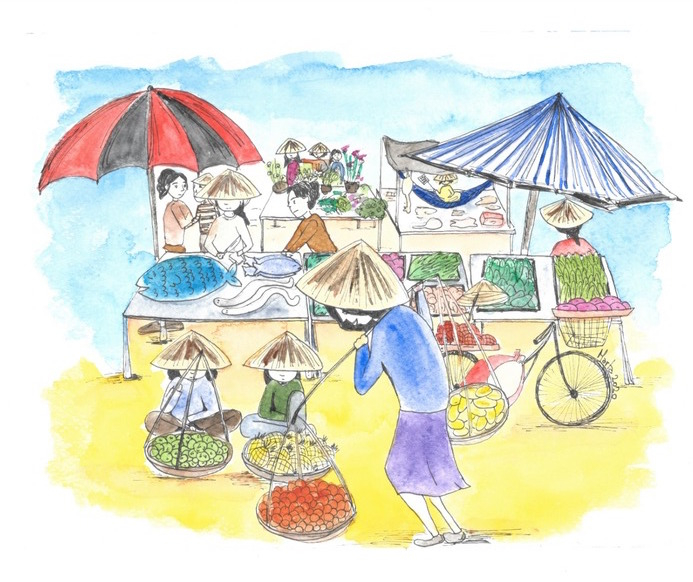
I furtively followed a woman who carried a bamboo stick on her shoulders to which two baskets were tied, one full of mandarins, the other of mangoes. I imitated the dance with which she crossed the intersections and I stopped only when she stopped – to have breakfast with Phở soup. We got lost in narrow streets, we paraded through discreet temples and daring shops and finally we reached the central market. It was a triumph of colors and smells: stands of flowers and spices, fish I had never seen before, sea turtles and eels; stands of dried shrimp, exotic vegetables, dried fruit; meat stalls with women that tirelessly waved rags to keep the flies away, while sitting on the hammocks hanging in the middle of the stand.

In those few hours I fell in love with Hanoi. I liked to look up and watch the tangle of electric cables that tied the houses to each other, producing a black jumble besides the large electric poles. Looking at those threads I thought: Hanoi is beautiful because it is frank, it shows itself for what it is. We hide the threads because they are unsightly, instead Hanoi made them part of its landscape.

Moreover, it is certainly a noisy city, but only because it is alive. On the wide sidewalks, sitting on blue plastic seats, young and old people pour out daily to drink filtered coffee with condensed milk, Saigon beer, or lemonade. They smile little and talk a lot. 

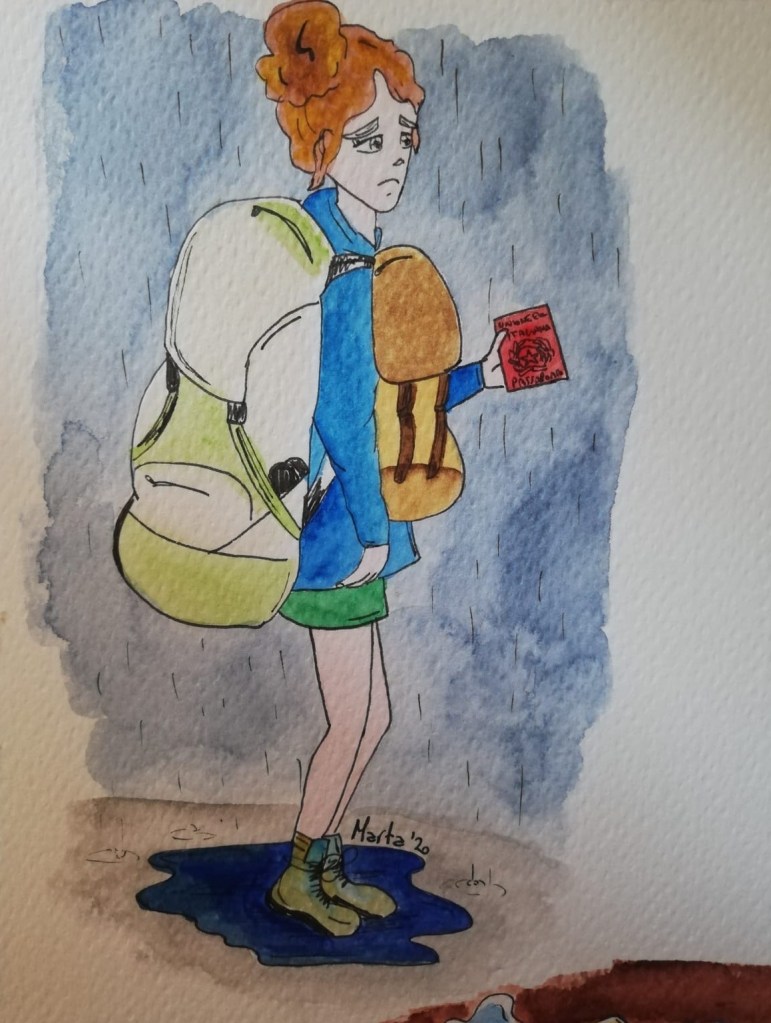
However, when I was finally getting comfortable with the atmosphere of the city, Hanoi changed. At first imperceptibly, then furiously. The first sign arrived on that same first day when, back at the hostel, they informed me that I would have to leave it within an hour. Some days before, the Coronavirus had begun its massacre in Italy and they feared I could infect them. I tried to open the passport and show them the stamps that proved that my journey far from Italy had started long before the virus arrived. And yet, they were only interested in the first page: Italian passport. I felt humiliated mostly because it happened just when I chose to open my heart to Hanoi. Backpack on shoulders, passport in hand, I went out into the streets.

Illustrations by Marta Cerreti

That day I learned that in Hanoi it starts to rain at 4.00 p.m. and the rain does not warn you. The sky darkens within instants, then, it brushes through the city. Thick. Tireless. Powerful. That day the rain watched me walk in search of a hostel, but it wasn’t the smiley rain of the day before: this time it was sneering. Once I finally found a place to sleep and dried myself, I easily regained the right spirit: it had been, I said to myself, an isolated event. And in fact, provided that I avoided revealing my nationality, Hanoi was more welcoming every day.

I found it a funny city: during mornings ruled by women busy in sales, in the afternoons crossed only by men, grouped around a high and wide pipe, smoking the Thuoc Lao.

Illustrations by Marta Cerreti

I liked how everyone stopped to greet me while I was painting on the roadside and how many engaged in acrobatic hand gestures to explain me how to play at Xiangqi, their board game. As days passed I became able to distinguish the smells of the streets: fish sauce, beef soup, fried chicken legs, spring rolls. I felt welcomed and when a few days later I left the city to visit the rest of the country, I felt almost certain that the little accident in the hostel wasn’t real.

For two weeks I wandered through the rice fields of the north until I arrived in the warm and sunny lands of the south. I explored magical places, but something was out of tune, both inside and outside of me. Travelling became increasingly complicated, seeing entire cities in lockdown and many checkpoints for measuring people’s body temperature, became more and more frequent: it was time to return to Hanoi.

To welcome me there was a very different city. No longer the lively and passionate one of two weeks before, but an intimidated and hostile Hanoi. A city aware of not being privileged with the permission to get sick, as it is almost completely deprived of public health. Most of the hostels had closed and at the entrance of some restaurants it was written: “NO tourists”. In many others, before I could even get across the doorway, the whole room froze and the owners waved their hands into a big “X” adding: “Finish, finish!”.

That day I experienced what it really means to get cozy around a city. Hanoi was terrified of me but, paradoxically, it continued to treat me informally as a member of the family. But this time, it did so to order me to leave. Of course, I still heard the city breathe with me, we were still able to smile behind each other’s suspicious frowns and blue masks. But that city called me a foreigner and treated me as a stranger. How bad it was not to feel welcome in the country I had chosen to visit! So I thought how difficult it must be not to feel welcomed in the country someone has chosen to stay in.

Here is the lesson I drew from my journey: being on first name terms before the unknown, feeling comfortable around the unfamiliar, requires a great act of trust. It can be the beginning of a long friendship or the weapon that will wound you. Hanoi welcomed me and abandoned me. But when I packed my things, I greeted the city with a familiar smile which meant: I categorically refuse to return to the hypocrisy of informal language. I think Hanoi understood it, because it smiled back. After all, it is such an electrifying experience to be able to call a city by its own name!

Damned the day I moved there

I moved to Milan on January 13th in 2020. Nobody spoke about the virus, even if at that time COVID-19 had already started spreading in Lombardy. Maybe the virus had travelled on a train like me. Maybe it had scattered in the large halls in the Central Station, holding on tight to someone’s backpack while he was going somewhere else.

Perhaps he had taken a taxi to the city center and who knows if he had bumped into the taxi driver who was so mad at Beppe Sala because of the works for the new underground line, the M4. «Instead of going through all this trouble, he’d better add other stops on the yellow line and it was gonna be okay. All this noise.. and then… all that money for nothing! We will be stuck in this situation until 2021».

What I enjoyed the most of the accommodation I managed to find, after months spent signing up to several rental companies online, is the area. It is close to San Lorenzo Columns, known as one of the most lively places of Milan nightlife. That place is very important to me. In that crossroad between Corso Porta Ticinese and Via Molino delle Armi, there is Farini where I had my first aperitif almost two years ago. At that time I did not know that one day I would move just there and honestly I thought that Milan was rather dull. Yet at that very moment I realized I was happy after long time. Rome, my beautiful Rome, had not been able to make me feel like that.

It’s not very different from how you feel when a stranger can understand you better than a friend.

Moreover, this area reminds me one of my favourite movie by Carlo Verdone: Damned the day I met you (1992). In the movie Margherita Buy lives in a flat just close to San Lorenzo Columns. I would say that the neurotic relationship between the two protagonists, Bernardo and Camilla, perfectly reflects the one between Milan and me.

I can’t stand it but at the same time it makes me have fun like few others.

Scene by Damned the day I met you

In some periods I need to be far from her but, even if I don’t want to admit it, I know that I’m in love with her. In front of Farini there is a bookshop called Verso, one of the most lively in Italy. They organize book presentations and make good appetizers. On Valentine’s day there was a book launch event. They had invited the writer Marco Missiroli , a milanese of adoption, whose Atti osceni in luogo privato I had already started reading. It is a novel which is partly set in Milan and the fact that I knew almost all the streets mentioned in the book gave me the impression to feel at home. Actually, that night I decided to go to Tongs, at the Navigli, to have an aperitif with my friends. It was our first night spent all together in the trendiest place in Milan and it would be also our last light-hearted night.

In the end I went back home before the others because I was tired. This is why that evening is on the top in the list of my regrets with all the other things I have never done, I have never said, I have never lived to the extreme before the virus. While I am writing I feel unusual sensations. It seems I am referring to someone else’s life and I am writing as if I were observing from the top as an omniscient narrator.

The pandemic we are experiencing has marked a watershed between the before and after, creating a hole between these two time spaces. It’s difficult to speak about something which is still happening but I will try.

In the beginning what made me feel anxious was how the city was changing dramatically. I know that it is nothing if compared to the infernal situation in the hospitals and in many houses. Actually that deafening silence talked to me more than the 6 pm news.

Looking out the window and looking at the Columns, I could not hear any voices, I could not see the busy people in their everyday life any longer. Unthinkable for every city, but in particular for Milan.

Photo by Ilaria Palmieri

It is not necessary to live here to know what Milan has become in the last years. If Rome is the place of inspiration, Milan is the place where everything starts.

She is the engine, the hotbed of new talents, the laboratory. The endless speed and pragmatism. She is not like the other Italian cities. She has become the city.

In the last few years I have seen a large number of young graduates who have moved to Milan. For my generation, which is so skilled as it has never been before, but penalized for a lack of perspectives, this city has become the only alternative to the idea of leaving Italy.

I do not want you to think that my relationship with Milan has no conflicts. There were periods during which I did not stand the idea to be confined to a place that, after all, did not belong to me, where I promised never to return, and that I consider responsible of this calamity. However Milan still reminds me a lot of things I cannot forget.

That evening at the end of January when I went to Feltrinelli bookshop in piazza Piemonte for the launch of the book about Craxi by Claudio Martelli ( a few days later I would see the film Hammameth )in a crowded cinema where people were so thrilled to see the story of the most popular milanese of the Italian history . I got there very early and a very elegant gentleman in his seventies started to strike up a conversation. He was very nice and he reminded me my grandfather.

While waiting for the beginning of the presentation I spent an hour listening to him telling me the story of all his life. He had attended the same school as Martelli, he had lived in the so called Milano da bere , he became a very famous entrepreneur, he fell in love with a woman from Rome when he was already married. Meanwhile the mayor Beppe Sala and the President of Lombardy Luciano Fontana had arrived. Suddenly a man who was sitting in front of me collapsed and we two, unexpected protagonists of the scene, had to help him to stand up while the shocked lecturers were calling an ambulance. In the end we wished each other “Good luck !” and we said good bye with the typical nostalgia which is usually felt when we are aware that something did not last long.

I also remember that morning when a lady sent me a message on instagram saying she had found my atm card. I was a bit buzzed and happy because I had spent the night with Miriam in a wine bar, and it might have dropped when I went out of the underground station. The nuisance of the long queue at the office to have a new card and the thought that someone was traveling undisturbed with my card were already haunting me. On the contrary the lady left it in a bar in corso Vittorio. She had put it inside an envelope on which she had written ” for Francesca”.

I remember that evening when I queued up for three hours to see ” The Law of the dreamer” by Daniel Pennac, inspired by Federico Fellini. In the beginning there were just twenty people but then the number of people increased dramatically. It was the first stage of the tour of the French writer dedicated to the relationship between Fellini and his dreams. They had chosen Milan for this important debut. Pennac started the performance by recreating one of his childhood dreams: the lamp on his dressing table starts dripping. The light becomes an uncontrollable liquid and fills the whole room, even the whole city like an irradiating tsunami .

If someone asked me about the end of this story I would answer just like that: it is like a regenerating light which hides everything and gives us the opportunity to start a new life. I sometimes think if the virus was with me in all those events I have just narrated. It was on the hands of a gentleman while he was sitting to listen to Martelli, on my ATM card or flying freely among Pennac’s words. Maybe Yes, maybe no.

Perhaps it is always the same story: in any outburst of life there is also a little death.

Once more Milan made me understand something that actually I already knew.

Photo by Ilaria Palmieri

Histoires d’un confinement parisien

Beaucoup envient ma vue, aucun les escaliers

Frédric Chopin

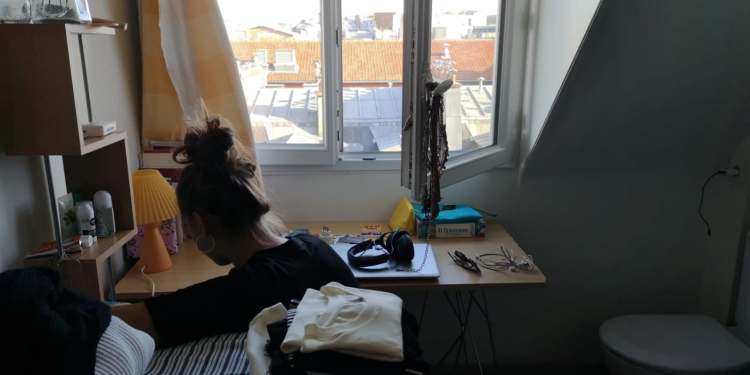
Qui sait ce qu’Erika a éprouvé quand, en mars dernier, quelque temps après avoir obtenu son diplôme, elle s’est postée à la fenêtre de son studio. Qui sait si lors de cette soirée-là les toits de Paris lui sont apparus différents. Aucune proclamation solennelle dans une salle universitaire, ni une aucune couronne de laurier lui ceignant la tête, mais seulement le silence d’une ville vue d’en haut. 

Mansarde de Erika

Erika a terminé comme ça, en pleine solitude, son parcours d’études long de cinq ans : un double diplôme en droit grâce à un jumelage avec l’Université Paris Nanterre. Dans la capitale française, elle a décidé d’y rester vivre, si bien que dans les prochains mois elle soutiendra le barreau en France. 

Elle me confesse que, depuis qu’elle est confinée seule, elle a commencé à vivre cette période comme une opportunité. Paris est une ville qui te demande toujours d’aller vite. Maintenant, enfin, elle peut retrouver un peu de paix. 

En France, le danger du Coronavirus n’a pas été perçu comme réel jusqu’à la déclaration d’Emmanuel Macron du 12 mars, lors de laquelle le président a défini la plus grande crise sanitaire que la France ait jamais affronté depuis des siècles. Après avoir annoncé des restrictions ainsi que la fermeture des écoles, il n’a pas reporté le premier tour des élections municipales ni annoncé l’obligation de confinement, qui a seulement été décrétée cinq jours plus tard, le 17 mars. Depuis cette date, beaucoup de jeunes vivent leur confinement dans des studios, qui mesurent souvent entre 9 et 30 m², ou un peu plus lorsque l’appartement est partagé. 

Y a-t-il un mode d’emploi, comme dirait l’écrivain Georges Perec – qui connaissait bien les espaces parisiens – pour affronter l’expérience du confinement dans un logement si petit sans devenir fou ? 

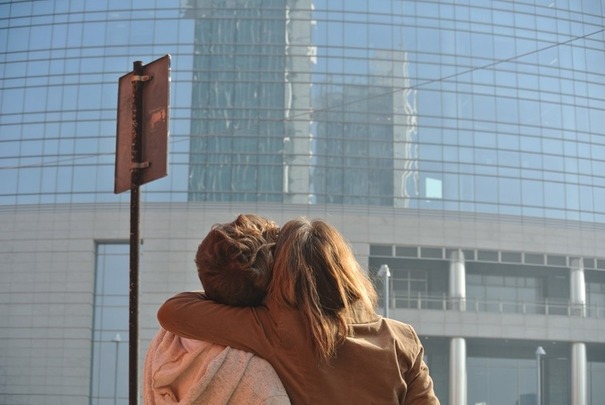
Photo de Marta Bevacqua

La réponse semble se cacher dans cette photographie de Marta Bevacqua, prise durant sa quarantaine à Paris. L’image donne une piste d’antidote possible. La solution est à chercher dans la créativité et dans l’imagination, dans des gestes apparemment inutiles, mais salvateurs : transformer un drap en une tente, jouer avec la lumière et avec les ombres, se familiariser avec l’enfance. En bref : se sentir vivants. 

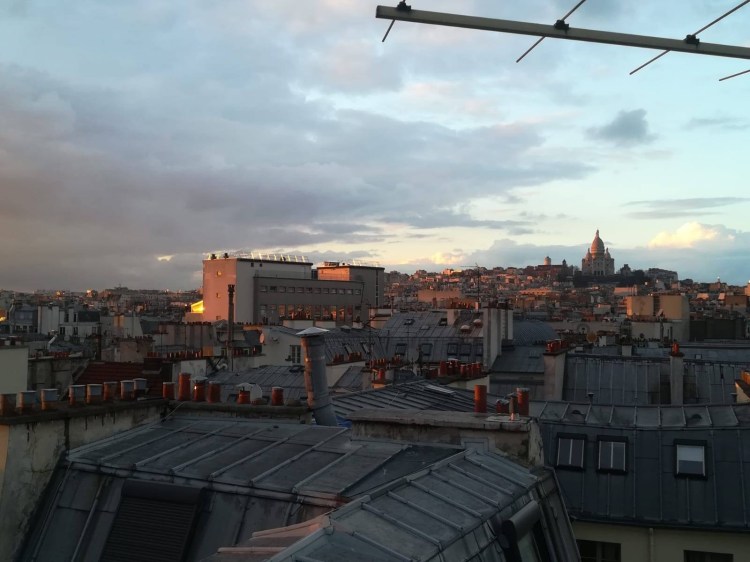
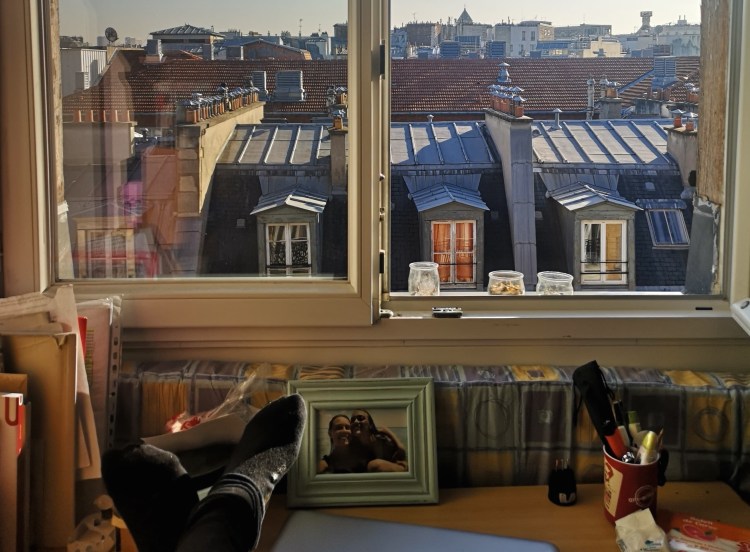
Diego pense la même chose. Vingt-sept ans, de Cuneo, il vit à Paris depuis trois ans et travaille comme ingénieur biomédical. Après des semaines de confinement dans un studio de 30 m² avec vue sur le Sacré-Coeur, il a compris qu’il n’y avait qu’une seule manière pour éviter de se laisser aller : bien organiser l’espace. Qui vit dans un grenier connaissait bien la règle de l’ordre bien avant le confinement. En revanche, l’organisation du temps est une nouveauté. Car si jusqu’il y a quelques semaines, on restait peu dans les studios parisiens, dorénavant ce sont heures en enfilade qui se succèdent. Ainsi Diego, pour “survivre” – en plus de travailler – lit, étudie, joue de la batterie et de la basse. Au lieu de se concentrer sur le problème, il lève les yeux et se sent chanceux d’avoir un paysage ainsi devant lui. 

D’en haut, il me dit, tu rejoins avec les yeux des points de la ville que tu ne peux pas voir ailleurs. 

Vue de la mansarde de Diego

Parmi les récits que j’ai recueillis, certains se ressemblent. Andrea, par exemple, a différents points communs avec Diego. Ils ont le même âge, ils viennent de la région de Cuneo et tous les deux travaillent à Paris comme ingénieurs. Et, comme si ce n’était pas assez, ils vivent le confinement dans un studio. Seulement le quartier n’est pas le même. Diego habite près de Montmartre et Andrea, Porte de Vanves. Ingénieur en génie civil, il travaille à la construction d’une des nouvelles lignes du métro de Paris. Pour lui la maison a toujours été un lieu ouvert. Elevé dans un petit village de campagne entre le vert des arbres et une cour, où son grand-père, assis sur un banc, lui racontait les jours difficiles qu’il avait vécus durant la campagne italienne de Russie.

Mais avec le temps, Andrea a appris à repenser son concept d’abri. D’abord, il a quitté la maison ouverte sur le jardin pour déménager dans une chambre d’un campus, et ensuite, il est allé à vivre dans une colocation pour enfin déménager plus tard dans un studio de 50 m², dans lequel ils sont deux. C’est sûr, il y a des jours plus difficiles que d’autres pendant ce confinement, mais Andrea se laisse séduire par les actions du quotidien, toujours les mêmes, mais rassurantes dans leur répétition. 

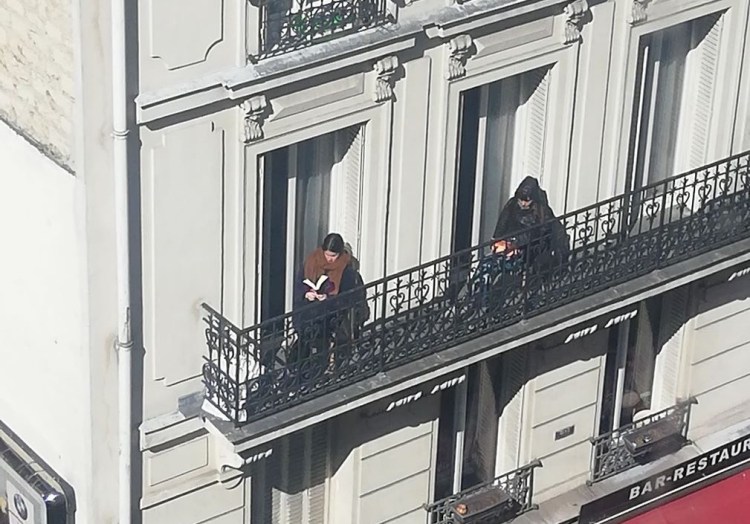
Il s’est habitué au soleil, qui le matin inonde de lumière sa chambre, et à certaines présences, comme ces deux filles qui lisent sur le balcon.

Vue de la mansarde de Andrea

Toute le monde m’a raconté ce que l’on éprouve à vivre avec la tête entre les toits, juchés sur Paris comme des chats perchés. Seulement, Agata a choisi de décrire un toit en particulier, le sien, où elle vit ses meilleures heures. Cet espace, qu’elle rejoint au moyen d’une petite échelle, est devenu avec le temps un lieu de sociabilité, qu’il est impossible d’avoir dans un studio. Sur le toit, Agata invite ses amies à faire des soirées, mais c’est aussi un lieu qu’elle aime vivre en solitaire, profitant du coucher du soleil. 

De la terrasse de Agata

Agate est la seule à parler des escaliers, ces infinies marches qu’il faut affronter chaque jour pour rejoindre le studio. A ce propos, il me vient en tête une phrase de Chopin. Quand à vingt-ans, il quitta Varsovie pour déménager à Paris, il trouva sa première tanière dans un grenier, au numéro 27 du boulevard Poissonnière. Dans une lettre, il dira : “Beaucoup envient ma vue, aucun les escaliers”. Le scénario n’était pas très différent de ce à quoi fait face Agata. Elle aussi aujourd’hui, comme Chopin alors, admire Montmartre en se mettant à la fenêtre.

Les escaliers de la maison de Denis

S’il est vrai que les escaliers en colimaçon représentent sans aucun doute un autre des inconforts de la vie dans les combles parisiens, il faut néanmoins admettre qu’ils présentent un attrait tout particulier. Chaque fois que je les parcours, arrivée presqu’à la moitié des six étages, regardant en bas, je suis prise de vertiges, aussi bien en pensant aux étages qui m’attendent qu’à la hauteur et à la sensation de vide que je ressens.

George Perec, dans Espèces d’espaces, écrit : “On ne pense pas assez aux escaliers. Rien n’était plus beau dans les maisons anciennes que les escaliers. Rien n’est plus laid, plus froid, plus hostile, plus mesquin, dans les immeubles d’aujourd’hui. On devrait apprendre à vivre davantage dans les escaliers. Mais comment ?». 

Et dans un texte qu’il publiera plus tard, La vie, mode d’emploi, toujours dédié aux espaces et aux appartements parisiens, il ajoutera : «Dans les escaliers passent les ombres furtives de tous ceux qui furent là un jour».

Gravissant les marches qui mènent aux mansardes, celles qui étaient autrefois les “chambres de bonne”, les domestiques, qui travaillaient dans les appartements des familles de l’immeuble, on remarque qu’il y a une porte à chaque étage. Avant, c’était de là que les dames de service accédaient directement à la cuisine de l’appartement. J’entends souvent, en passant à côté de ces portes, les voix des familles qui se mettent à table, les bruits des assiettes et les cris des enfants qui ne veulent pas aller dormir. Pour autant que soit fascinante la vie dans une mansarde comme celle de Baudelaire, en entendant ces voix de l’autre côté de la porte, on ne peut pas ignorer l’injustice d’un système social, qui n’offre à beaucoup aucun autre choix que celui de vivre dans un espace aussi exigu.

Un immeuble haussmannien, aujourd’hui comme hier, est une étrange pyramide sociale inversée. En haut, sous les toits, vit celui qui ne peut pas se permettre un appartement, et aux étages inférieurs, en revanche, il y a les riches.

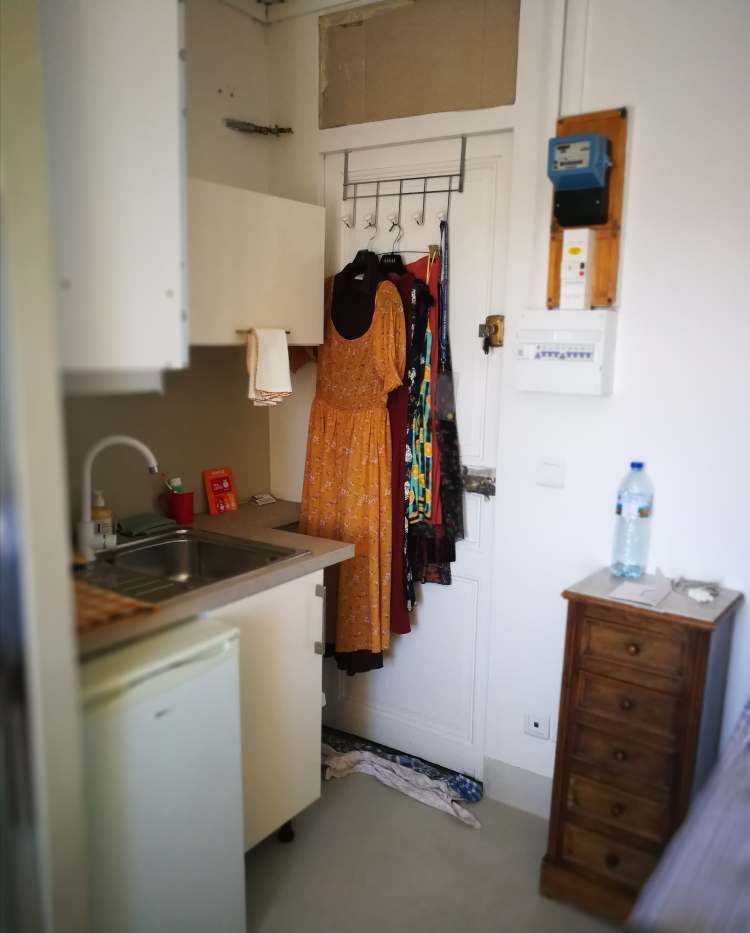
La mansarde de Sara

La plus jeune de ceux que j’ai interviewés est Sarah, vingt ans, étudiante en sociologie à Padoue et en ce moment en Erasmus à Sciences Po. A Paris, elle habite dans une mansarde de 9 m² au septième étage d’un immeuble du VIème arrondissement, à Saint-Germain-des-Près, à deux pas de l’université. Son logement pourrait sembler à beaucoup un lieu cauchemardesque, à cause des dimensions réduites et de ces cabinets accolés à la cuisine. Pour elle, cet espace est devenu avec le temps son poste d’observation sur Paris. Les toits, me raconte-t-elle, apparaissent comme une étendue marine par leur couleur bleuâtre, encore plus maintenant que tout s’est arrêté et que les mouettes ont réinvesti la ville.

La mansarde de Sara

Quand elle n’avait pas envie de rentrer dans son minuscule appartement, elle demeurait le plus possible dehors. De toute façon, à Paris, ce ne sont pas les activités qui manquent. Mais maintenant, depuis le début du confinement, tout est différent, parce que les escapades ne sont plus autorisées. Après la première semaine d’isolement, sans pouvoir faire plus de trois pas et sans pouvoir pratiquer aucune activité physique, elle a déménagé chez une amie, dont le colocataire était retourné en Italie.

La mansarde de Sara, d’ordinaire si vivante, rappelle bien maintenant qu’elle est vide le moment que nous sommes en train de traverser. Affairés, avec en tête les départs, les voyages, les aventures, comme frappés par un vent venu de loin, nous avons dû nous arrêter.

Ils sont nombreux les lieux parisiens qui depuis le 11 mai, date de début du déconfinement en France, commencent à lentement reprendre vie. J’imagine les mansardes redevenir ces espaces que l’on effleure le soir et les terrasses, comme celle d’Agata, avec le temps se remplir de nouveau d’amis. J’imagine cette lumière d’été qui à Paris est encore forte à dix heures du soir. Et puis je pense à quelqu’un qui rentre à bicyclette, parcourant la Seine, et Sara ou une autre fille pleine d’espoir comme elle qui, postée à la fenêtre, rêve la ville qu’elle a devant les yeux et la confond avec la mer.

Vue de la mansarde de Sara

Photo de couverture: Andres Salvatori

Natalia Ginzburg. “La città e la casa”: il racconto di un’assenza

Nella piccola casa dove sono cresciuta, c’era una libreria che occupava tutto il muro del soggiorno e che a me sembrava immensa. Forse un ospite di passaggio non avrebbe potuto indovinarlo, ma era divisa in due sezioni: a sinistra i libri di mio padre e a destra quelli di mia madre. C’erano dei doppioni qua e là, ma a uno sguardo attento si aprivano due mondi molto diversi.

Nella parte di libreria di mio padre si susseguivano in modo ordinato libri storici, romanzi di spionaggio, gialli, libri di inchiesta. Erano tutti molto grandi e disposti in modo ordinato. Quella di mia madre invece era molto più caotica, vi erano accatastati libri molto più esili, uno sopra all’altro, disubbidienti. Letteratura francese soprattutto, alcuni saggi di psicologia, volumi di poesia. Sugli ultimi scaffali, alcune partiture per pianoforte. 

Di certo tutti quei volumi erano stati letti da entrambi i miei genitori, tuttavia rimaneva forte una distinzione: i libri di mio padre da una parte, quelli di mia madre dall’altra.

Con il passare degli anni ho esplorato entrambe le librerie ed è capitato che mi affezionassi tanto a dei libri da spostarli dalla libreria dei miei genitori alla mia: libri troppo importanti per lasciarli tornare alla loro postazione iniziale.

Della libreria dei miei non mi piaceva tutto. Tra i libri di mia madre che per lungo tempo non ho avuto interesse a leggere, ci sono stati quelli di Natalia Ginzburg. Ne diffidavo per i motivi più sbagliati: erano tutti uguali, ugualmente brevi, ugualmente ingialliti di un giallo squallido, tutti edizione Einaudi rigida, senza copertina. Non avevano un’identità. È stato necessario che ci incappassi quasi per sbaglio, in una giornata di sole che mi aveva lasciato senza altro da fare, per scoprire quanto mi fossi sbagliata

Le parole di Natalia Ginzburg sono pennellate brevi e decise. Sembrano raccontare una storia semplice e comune, ma quando si chiude l’ultima pagina ci si rende conto di aver scorto un decennio, una nazione, un universo.

È così che accade con La città e la casa, romanzo epistolare pubblicato nel 1984 e che racconta la storia comune di gente normale. I protagonisti vivono amori e passioni banali, commettono errori troppo semplici per poter essere apprezzati. Sono personaggi ordinari con nomi un po’ antiquati: Alberico, Ferruccio, Albina, Adelmo.

La città e la casa è, prima di tutto, la storia di Giuseppe, un uomo che ha ormai superato la cinquantina e che si trasferisce in America da suo fratello perché, a suo dire, non ha niente che lo leghi a Roma. Ha un figlio ventenne, ma suo figlio non gli piace. Ha una casa, ma la vende in gran fretta, senza pensarci troppo. Ha degli amici, ma i suoi amici non sono abbastanza per trattenerlo. Ha una vecchia fiamma, Lucrezia, ma quello non era vero amore. E allora parte per l’America, dove lo aspetta Ferruccio, suo fratello maggiore. Parte convinto che al suo fianco si sentirà di nuovo bene e potrà finalmente scrivere il romanzo che ha sempre voluto scrivere. Parte per trovare se stesso ma finisce per vivere la vita del fratello, il quale muore pochi mesi dopo che Giuseppe si è stanziato in America. Si sposa con la vedova di Ferruccio, lavora dove lavorava il fratello e vive in quella che era stata casa di Ferruccio. 

A niente servono le preghiere degli amici che gli scrivono di tornare a casa. Giuseppe non tornerà mai, come se tornare significasse fallire. Eppure già prima di partire sapeva bene che Princeton non sarebbe mai stata né la sua città né la sua casa:

Cammino molto per Roma. Ieri ho preso l’autobus e sono andato in piazza San Silvestro. Non è una gran cosa, piazza San Silvestro […]. Però l’ho salutata a lungo e amorosamente. In America ci saranno altre piazze, con turisti, mendicanti e sirene. Ma a me saranno indifferenti, perché non è che uno nella vita può fare sue troppe cose. Ad un certo punto della vita, tutto quello su cui posiamo gli occhi per la prima volta ci è estraneo. Lo guardiamo da turisti, con interesse ma freddamente. Appartiene agli altri.

Roma, Giuseppe l’ha salutata. Sarà sempre la sua città, ma non è più casa sua. La dicotomia casa/città è il perno di questo breve e intenso romanzo. Se Roma è senza dubbio la “città” del titolo del libro, non è così facile individuare la “casa”. 

Nelle prime pagine, quando ancora tutto è immobile, la funzione profonda di casa è svolta dalle Margherite, il grande casale di campagna di Monte Fermo dove vivono Lucrezia, Piero e i loro figli e attorno a cui ruotano tutti gli amici di Giuseppe. Attraverso le lettere che il gruppo di amici si invia per aggiornarsi, si scopre che l’immobilità è finita: Lucrezia e Piero hanno divorziato perché Lucrezia si è innamorata di Ignazio Fegiz e di lui è incinta; tuttavia la passione di Ignazio termina presto e Lucrezia si trova costretta a vivere a casa di Roberta, mentre la casa delle Margherite viene venduta. 

Alberico, il figlio di Giuseppe, ha invece riconosciuto come sua figlia la bambina della sua amica Nadia e si è trasferito con lei nel palazzo dove vive anche Egisto, a piazza San Cosimato. Ad un tratto sembra che la funzione di casa possa essere svolta proprio da questo palazzo attorno a cui orbitano Roberta, Lucrezia, Ignazio, Albina, ma in un attimo anche questa possibilità scompare, perché scompaiono le persone che la facevano vivere: Nadia muore in una rissa e Alberico accetta di cedere il ruolo di tutore della bambina ai ricchi genitori di Nadia. 

C’è un terzo tentativo di “fare casa”, ma anche questo fallisce bruscamente: proprio mentre Alberico sta tentando di  ricomprare la casa che suo padre Giuseppe aveva venduto prima di andare in America, muore anche lui. In una delle ultime lettere, Egisto scrive ad Albina: “Peccato che tutti quei soldi che aveva Alberico, vadano a una persona che non ne ha nessun bisogno, con tanta gente che fa la miseria”. Mentre tutti i possedimenti di Alberico vanno in eredità alla bambina di Nadia, il gruppo di amici vede sbiadire anche questa nuova possibilità di sentirsi a casa.

Non le Margherite, non la casa di Piazza San Cosimato, non la vecchia casa di Giuseppe. Qual è la casa a cui si riferisce Natalia Ginzburg nel titolo La città e la casa? Questa domanda rivela la meravigliosa complessità del libro. A renderlo complesso non è la quantità di eventi che accade o i molti personaggi che ne prendono parte. È un libro difficile perché tutto ciò che accade non sembra richiedere alcuno sforzo da parte del lettore. 

È una scrittura pulita ed essenziale, quella che racconta i mutamenti di vita di queste persone. Muore il fratello di Giuseppe, muore Nadia, muore Alberico, muore la moglie americana di Giuseppe, muore il bambino neonato di Lucrezia, ma le morti non straziano né i personaggi né il lettore, gli accadimenti rimangono all’esterno, sulla superficie della pelle. Sono tutti solo spettatori delle vite altrui, nessuno vive il dolore completamente. Non c’è pathos, solo una lenta e inarrestabile rassegnazione perfettamente descritta da lettere che rimangono sulla superficie degli eventi, perché solo la superficie può davvero spiegare un’ assenza. 

È la casa la grande assente di questo libro: una casa si costruisce con costanza ed amore, mentre questi personaggi sono individui solitari dalla prima all’ultima pagina. Lucrezia e Giuseppe hanno avuto una storia alle spalle di Piero, Giuseppe ha scritto un libro che nessuno ha mai avuto il tempo di leggere, Alberico ha prodotto un film che nessuno ha apprezzato; quando Serena realizza finalmente il sogno di recitare nella Mirra, i suoi amici non fanno che sminuirla. Sono persone che si sono incontrate, hanno camminato accanto e talvolta hanno finito per amarsi, ma non sono state in grado di farsi carico del peso dell’altro. Quale casa può esserci con queste premesse?

La città è senza dubbio Roma, la casa invece, non c’è più. 

All’apparenza, La città e la casa è una lettura semplice e piatta. In realtà, è un romanzo articolato, vasto e necessario. A questo punto sarà chiaro che La città e la casa è migrato dalla libreria di mia madre alla mia. Perché è un romanzo troppo importante perché io lo lasci andare. 

Natalia Ginzburg, La città e la casa, Einaudi

A stroll around the Goutte-d’Or multicultural neighborhood in Paris

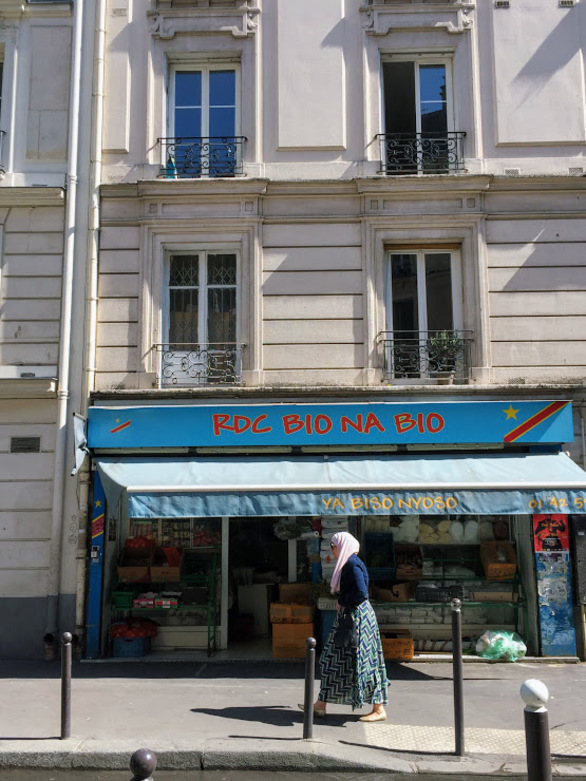
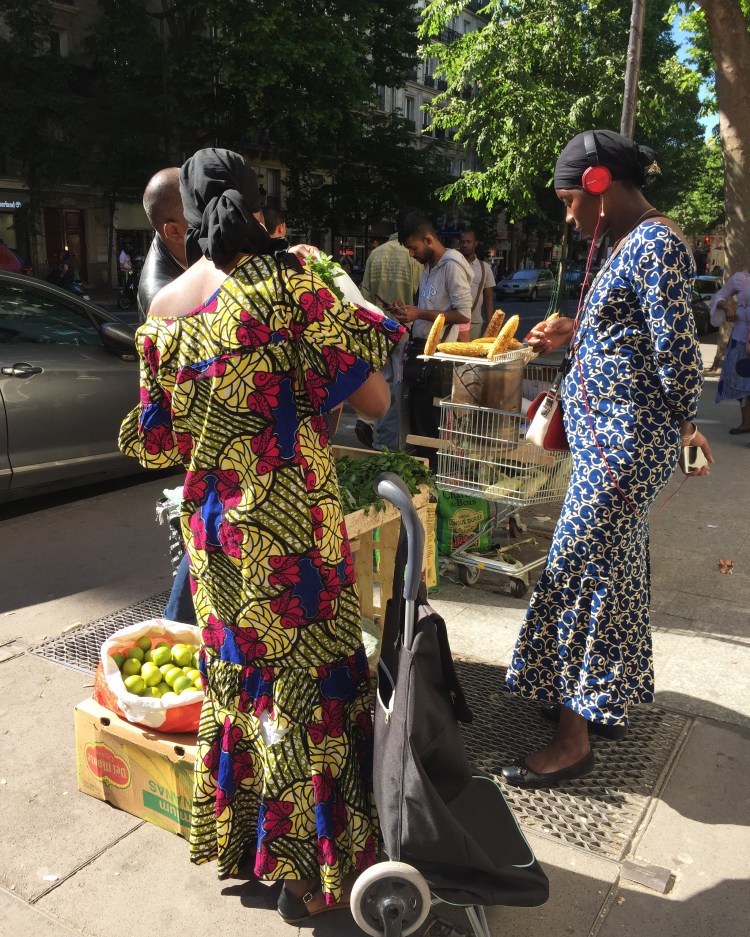
A perfect rectangle, the Goutte-d’Or neighborhood in the 18th district of Paris is bordered on the west by the Haussmannian Boulevard de Barbès and on the east by the rails of the Gare du Nord. The Rue Ordener and the Boulevard de la Chapelle, with its spectacular elevated subway, form its northern and southern borders. Its name, literally “the golden drop”, derives from a white wine variety produced in this area in the Middle Ages. Framed within the Rue de Chartes, you can see the Sacré-Cœur Basilica in the distance. But while the Montmartre hill, the authentic Mecca of all tourists, is just a few steps away, there is no place less beaten by visitors than this one. A working-class neighborhood with a high Sub-Saharan population and a “Sensitive Urban Zone”, the Goutte-d’Or is considered the heart and soul of African Paris. I go there on an early June Tuesday morning and though in Paris it’s the post-pandemic era and there aren’t many people around, the atmosphere is as vibrant as always. Outside the Chatêau Rouge metro stop some girls are handing out flyers to promote their beauty salons, the greengroceries are crawling with customers and the streets are already getting noisy. 

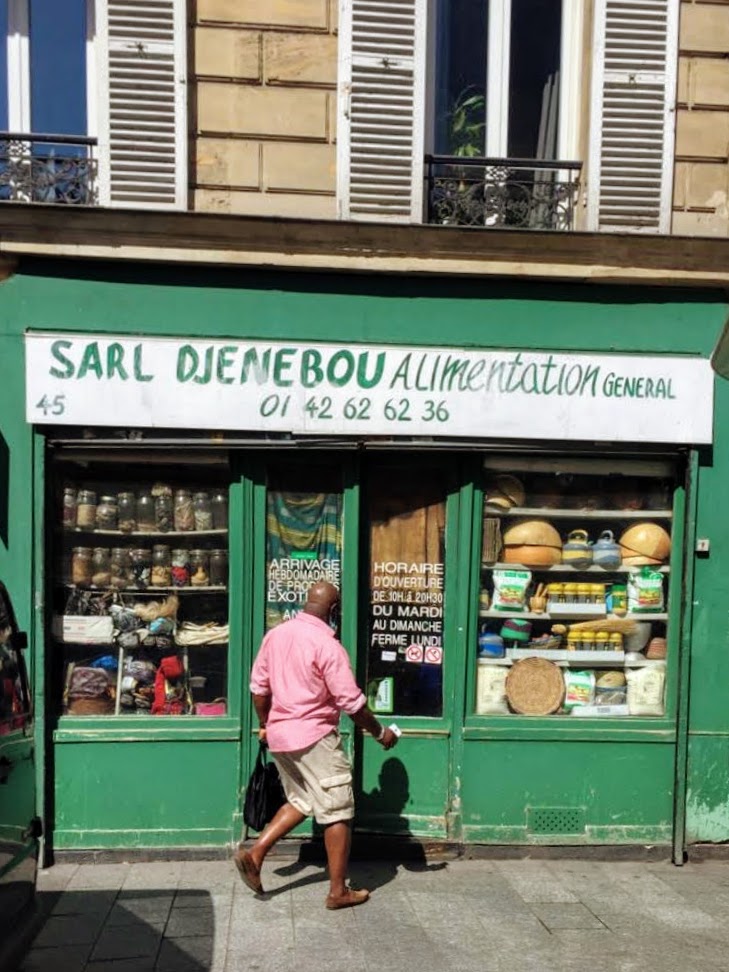
Right around the corner, in Rue de Suez, I find myself in the middle of the famous Dejean Market, with its many stalls of African products and exotic fruits. The people in the neighborhood come here from Monday to Saturday to find the ingredients, unavailable elsewhere, necessary to prepare traditional African dishes. Dejean market is filled with rare treasures: from bissap, the African hibiscus flowers juice, to yam, an edible tuber, from okra to cassava, from fresh herbs to sweet potatoes.

Outside the Dejean fish shop two fish sellers chat calmly while a third one helps a woman carrying two many shopping bags. The sidewalk is a watercourse: it has the scent of the sea. Down the street, crates of cooking bananas fill the market booths, bags of rice are piled on the floor and colorful, hand-written signs promote any sort of discount and bargain.

The épiceries of this neighborhood are ethnic rather than exotic and they specialize in very distinct products, specific to the different culinary traditions. After all, it couldn’t be otherwise in an area where more than thirty ethnic minorities coexist and forty different languages and dialects are spoken. In the rues Doudeauville and Mhyra, Malian, Togolese, Nigerian and Congolese grocery stores can be found, but also Senegalese or Cameroonian traiteurs. In Rue des Poissoniers, the sign of a store called Haiti Market is a reminder of French colonial past. Other signs recall Suez, Abidjan, Bamako, Lomé. The pastry shop El Andalousia, a small Arab dominion outside the Barbès area, fills the air with Algerian perfumes. The inner geography of the neighborhood and its economy gives an idea of the different migration waves that have followed in this area of Paris: Algerians in the ’20s, Tunisians and Moroccans in the ’50s, Malians and Caribbean people in the ’60s and Ghanaians and Sri Lankan in recent times. The Goutte-d’Or is a true crossroad of migrations, a place where ethnic identities are highly varied and share a diasporic past.

While the market is about to close, the streets start to empty and the crowd disperses. The sun shines bright and makes the people’s colorful clothes and hats glow. While I go north, towards the snake-shaped Rue Marcadet, I stumble into some African tailor’s shops overflowing with bright cloths, selling anti-Covid multicolored masks, all hand-made. In the same street I find a small African music shop, whose windows are covered in old CDs and DVDs covers that make it impossible to peer inside. And then Afro hair dressers’ salons, inexpensive perfume shops and beauty parlors, halāl butcher’s shops. The unauthorized peddlers, the kings of contraband cigarettes who usually play cat and mouse with the local police, are strangely absent today. A little further, a hipster record shop has recently opened its doors. And yet this neighborhood stays authentic and alien to any form of gentrification. Zadie Smith would probably call it “ungentrifiable”. While I walk to the closest metro station to go back home, on the other side of Paris, on the left bank, I think that the beauty of this little rectangle of Africa lies right there. It’s a place bubbling with creativity and contamination, whose diversity keeps it forever alive and genuine.

La Parigi di Gustave Caillebotte: intervista a Luigi La Rosa

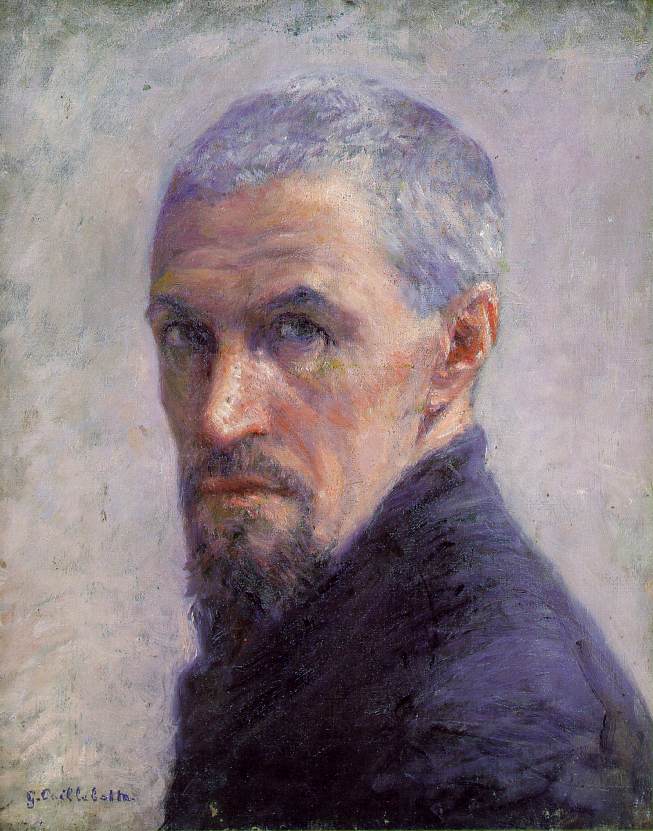
Luigi La Rosa è uno scrittore italiano e parigino. Nato a Messina, nella capitale francese è arrivato esattamente dieci anni fa e non l’ha più lasciata. In Italia, dove tiene dei corsi di scrittura per Rizzoli-Bur, torna sempre volentieri; ma è Parigi la città che ha segnato l’inizio della sua carriera letteraria e che Luigi non ha mai smesso di raccontare. I due titoli che l’hanno reso noto sono Solo a Parigi e non altrove. Una guida sentimentale e Quel nome è amore. Itinerari d’artista a Parigi, entrambi editi da Ad est dell’equatore. Il Touring Club li ha apprezzati tanto da commissionare al loro autore la scrittura della parte culturale e artistica dell’ultima guida verde di Parigi. Il nuovo romanzo di La Rosa, L’uomo senza inverno (Piemme), ha per protagonista Gustave Caillebotte, personaggio fondamentale come artista e come mecenate nella storia dell’impressionismo francese. Il luogo magico che fa da sfondo alla narrazione, ovviamente, c’est Paris.

Luigi, sin dai tuoi primi libri ti sei affermato come narratore di una città, Parigi, che era già stata raccontata nei modi più diversi e attraverso ogni forma d’arte. Come hai superato la paura del già detto, se l’hai avuta, e come sei riuscito ad evitare questo rischio?

Sì, c’era il rischio dello stereotipo, del già raccontato, di quella che potremmo definire “parigitudine”: un’atmosfera sentimentale, un alone magico, che per uno scrittore è mortale. Se cadi lì, cadi nel banale. La paura era grande. Ciò che mi ha spinto ad affrontarla è stata la scoperta che la mia Parigi è fatta di istantanee personali, migliaia di possibilità del mio sguardo. Questo vale per tutti i luoghi, ma per Parigi più che per ogni altro. Puoi raccontarla, attraversarla, decifrarla e interrogarla in infiniti modi. Se tu sei onesto con te stesso come artista, il tuo sguardo sarà originale.

C’è una lunga storia che riguarda gli italiani emigrati a Parigi: da Giuseppe De Nittis alla generazione Erasmus. Cosa si cerca a Parigi? È ancora la meta degli artisti?

Parigi è fatta anche di difficoltà e miseria. È sempre stato così. Non dimentichiamo che gli impressionisti erano quasi degli accattoni, l’arte non ha mai riposato nella ricchezza. Tuttavia, Parigi non ha perso il suo essere richiamo per gli artisti. In nessun’altra città mi capita di trovare gente con così tanti sogni nel cassetto: un dottorato, diventare giornalista o romanziere, lavorare nel teatro, nella moda o nella danza. Tutti lavori che hanno a che fare con l’arte, insomma. Può sembrare un cliché, eppure ancora oggi Parigi lo asseconda. È vero che ci sono città più attive e attrattive dal punto di vista delle possibilità concrete che ti offrono. Il richiamo di Parigi rimane però qualcosa di oscuro e attuale. Resta una città-palcoscenico, nonostante si arricchisca e si complichi di tutte le difficoltà del nostro tempo.

Raccontare la Parigi di fine Ottocento è stato un viaggio nel tempo per te? Dopo il lavoro di documentazione che hai fatto per scrivere questo romanzo, è cambiato il tuo rapporto con la città?

Qualcuno scherzosamente mi definisce un uomo nato nel Novecento ma con l’animo di un ottocentesco. Sono arrivato a Parigi senza interessarmi alla città com’è oggi, ma inseguendo quelli che io chiamo “spettri”: per me Parigi è ancora quella di Balzac, di Baudelaire, di Proust. Le mie suggestioni sono fascinazioni contemporanee, che hanno uno sguardo nel passato: dalla metà dell’Ottocento fino agli anni Venti del Novecento, quando Parigi diventa la città di Fitzgerald e Hemingway, di Modigliani. Poi sicuramente anche la Parigi di oggi ha un suo fascino. Mi accade, però, di camminare per le sue strade e di immaginare le carrozze che passano, sentire il rumore delle ruote. La mia è una città sognata, una Parigi letteraria.

La città è un grande spazio che si costruisce, e nel tuo romanzo racconti una Parigi che sta cambiando volto. Ci sono però anche altri spazi su cui tu ti sei focalizzato: le case della famiglia Caillebotte. Cosa rappresentano nella vita di Gustave?

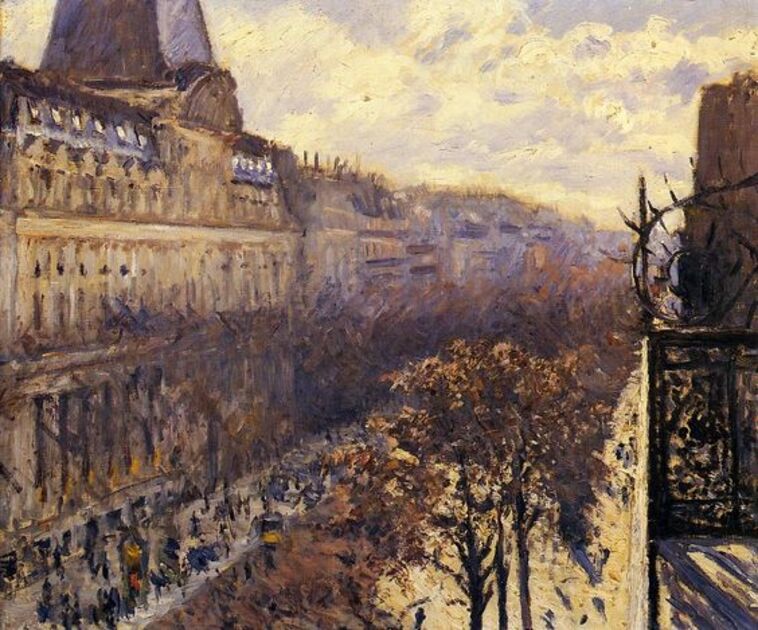
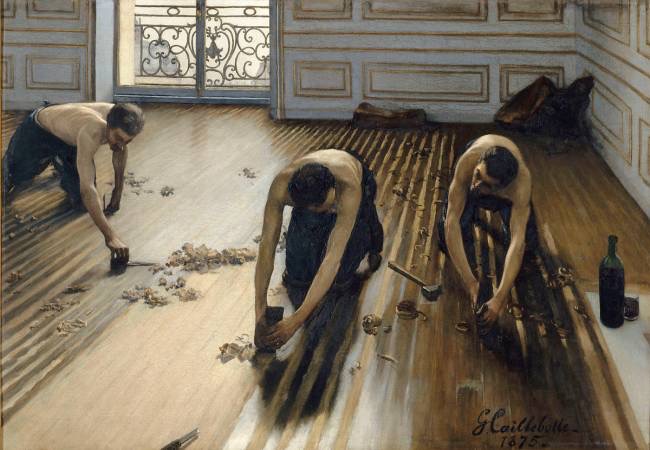
Credo che nessuno come Gustave Caillebotte sia stato pittore dello spazio. Ha reso l’architettura e gli spazi cittadini materia della sua pittura. I due spiriti più cittadini dell’Ottocento sono stati Baudelaire e Caillebotte. Il primo esaltava la folla, per lui la metropoli era l’energia da cui l’artista attinge. Il secondo fu un pittore-fotografo. Nella prima casa parigina, in rue Miromesnil, Gustave dipinse il famoso quadro Les raboteurs de parquet.

L’altra sua casa in città fu quella di Boulevard Haussmann, un grande appartamento con un balcone circolare che affaccia sul retro dell’Opera. Poi c’è la casa di campagna a Yerres, quella della villeggiatura estiva. Nel momento in cui il gruppo degli impressionisti comincia a rompersi, Gustave perde la sua ragione di vita. Entra in una sorta di crisi e per prima cosa abbandona Parigi: va a vivere a Gennevilliers, un borgo vicino ad Argenteuil, a un’ora da Parigi. Nella capitale tornerà solo da morto, per essere sepolto a Père-Lachaise. Quando la crisi entra dentro di lui, Gustave abbandona la città. È una sorta di morte spirituale, presagio della morte fisica che avverrà dodici anni dopo. Tornando alle case parigine, in quegli anni la capitale francese viene rasa al suolo e i palazzi ricostruiti secondo le logiche urbanistiche del barone Haussmann. Questo nuovo modo di concepire la città prevedeva l’uniformità e una perfezione sofisticata. Pensiamo alle balconate in ferro battuto, alle facciate pallide e curatissime nei dettagli. Questa Parigi è quella che Caillebotte vede nascere e ammira. Molto moderna, come moderna è la sensibilità di Gustave: pittore-cronista che ci racconta il secolo che si sta trasformando sotto ai suoi occhi.

Le stagioni sono fondamentali in questo tuo lavoro. L’inverno, nella sua assenza, dà il titolo al libro. Le altre tre stagioni danno i titoli alle parti in cui è suddivisa l’architettura narrativa. Rispetto ai piani temporali, come hai costruito il romanzo?

Tutto parte dal verso di Mallarmé posto in epigrafe. Il poeta parla di “lucido inverno”, la stagione dell’arte serena. Immediatamente, leggendo questo verso, ho fatto un parallelismo. Ho sentito che la stagione invernale, dell’arte matura e lucida, è quella a cui arriva ciascuno di noi: la vecchiaia. Siccome Caillebotte muore a quarantasei anni, per lui non c’è stata. Il titolo L’ uomo senza inverno allude a questo. Il romanzo è tripartito: primavera, estate, autunno. A ogni stagione corrisponde una stagione della vita del protagonista. Primavera è quando Gustave scopre l’arte guardando il quadro di Manet respinto dal Louvre, Le déjeuner sur l’herbe, e si accorge che nella vita vuole fare quello che fa Manet.

L’estate è una conferma e una maturazione di questa vocazione. L’autunno, invece, prelude alla crisi personale di Caillebotte. L’ho raccontato attraverso due aspetti. Il primo è la solitudine, dovuta al fatto che la sua famiglia si smembra: muoiono il fratello, il padre, la madre. A un certo punto Gustave si ritrova circondato da fantasmi. Questo accresce il suo senso di solitudine e il suo scoramento, forse anche in rapporto all’omosessualità non esplicitata. Poi c’è il secondo aspetto: la crisi dell’impressionismo. Caillebotte ha faticato a mettere in piedi questo movimento composto da gente rissosa. Gli impressionisti, per quanto fossero dei geni, avevano brutti caratteri. Erano uomini troppo diversi tra loro. Gustave deve tenere su una baracca che fa acqua da tutte le parti. Nel frattempo, si scatena la guerra franco-prussiana. Poi c’è la Comune. A un certo punto il movimento si scioglierà e ciascuno seguirà la sua via d’artista individualmente. Quando il gruppo, che per Caillebotte era una sorta di famiglia, si rompe, Gustave avverte un senso di solitudine legato sia alla sua vita personale sia a quella creativa. L’autunno prelude a questa crisi, che lo porterà a fuggire in campagna.

Dicci di più sugli impressionisti. Che tipi erano?

Ho fatto tante ricerche, ho letto molto su di loro. Fondamentale per me è stato il romanzo La vie moderne di Susan Vreeland, dove l’autrice si sofferma sui vari caratteri degli artisti. C’era Monet, quello più duro e risoluto, che fu molto provato dalla morte della prima moglie a causa di un cancro all’utero. Degas era abbastanza solitario e trattava malissimo le donne, picchiava le modelle con la canna da passeggio, però era un uomo geniale nella sua ricerca estetica. De Nittis, un animo dolce: fu il migliore amico di Gustave. Pissarro, uomo provato dal numero enorme di figli e dalla povertà. Cezanne, lunatico e bipolare: arrivava a Parigi, vi restava sì e no dieci mesi, poi stava male e tornava in campagna, ma a quel punto rimpiangeva la capitale. Insomma, ho conosciuto ognuno di questi personaggi e mi piaceva che il romanzo di Caillebotte fosse in realtà il romanzo dell’impressionismo. Gustave è il motore, il vettore che ci guida all’interno di questo affresco più grande di lui.

Ti definisci proustiano. Ne Il tempo ritrovato Proust afferma che il letterato invidia il pittore: anche chi scrive vorrebbe buttare giù degli schizzi, ma se lo fa è perduto. Qual è secondo te la differenza tra l’uso del tempo che fa uno scrittore e quello che invece fa un pittore?

Anni fa ebbi la fortuna di intervistare Michael Cunningham dopo l’uscita del film The Hours (2002). Raccontò un aneddoto molto bello su Monet. Quando chiesero a Monet, ormai vecchissimo, quale fosse il messaggio che voleva lasciare al mondo, lui rispose: “Che non ho imparato nulla”. L’intervistatore replicò: “Ma lei è il grande Monet! Come fa a dire questo?”. Allora Monet aggiunse: “Guardi i miei quadri. Lei riesce a sentire il rumore del vento e del tempo tra le canne? Se non riesce a sentire quel vento e quello scorrere del tempo, io ho fallito: non sono riuscito ad essere nulla”. I pittori – soprattutto gli impressionisti – hanno il bisogno di raccontare l’imprendibilità delle emozioni, nelle loro pennellate c’è sempre una fuga del tempo.

Credo che sia lo scrittore sia il pittore hanno l’esigenza di raccontare il tempo, perché fondamentalmente raccontano storie, seppure attraverso linguaggi diversi. Il tempo del pittore è fisso, l’istante di una storia. Quello dello scrittore, come dice Proust, è in costruzione: leggendo un libro tu senti lo scricchiolare del tempo. Il pittore, come il fotografo, deve scegliere un istante; lo scrittore ha invece l’ambizione di raccontare una storia in movimento. Pensiamo ai romanzieri, che si impegnano nella costruzione di una trama articolata e in evoluzione. Lì gli avvenimenti si avvitano su sé stessi e permettono quel gioco che è il divertimento di ogni narratore: saltare nel passato e nel futuro. La struttura del mio libro è un tempo lungo. La scelta di dare a ogni capitolo una data significa frammentare la durata della narrazione e raccontare le vicende come una somma di attimi, che tutti insieme ci danno l’illusione di una continuità.

Ne L’uomo senza inverno ci sono incubi con “nani dal volto di neonati”, presagi di morte. Ti sei ispirato al gotico?

Sì. Un’altra mia grande passione, quando mi rapporto a Parigi, è la sua dimensione gotica. È una città fatta anche di allucinazioni, di presagi. Le appartiene tutta una dimensione esoterica, magica. Mi è piaciuto giocare con questi elementi. Ad esempio, quando muore il fratello di Gustave, la morte è rappresentata come un avvoltoio che vaga sulle colline del cimitero. Non dimentichiamo che su Parigi sono state raccontate molte storie di fantasmi, vampiri, spettri. L’Horla di Guy de Maupassant, ad esempio. C’è tutta una tradizione letteraria su questa dimensione nera di Parigi, fatta di cieli bui, temporali, cimiteri, di sensazioni e di brividi che rasentano la realtà. Questa dimensione volevo che entrasse nel romanzo, ma in maniera molto distillata. Volevo che fosse una suggestione, e sono contento che sia stata percepita.

L’ultima domanda ci porta ai giorni che stiamo vivendo. Cesare De Seta, a proposito dei tuoi libri precedenti, pubblicati a pochi mesi di distanza dagli attentati alla sede di Charlie Hebdo e al Bataclan, ha parlato di “resistenza estetica” contro i fanatismi e contro il terrorismo. Si può usare la stessa espressione anche per questo tuo nuovo romanzo, uscito in un periodo di pandemia?

L’uomo senza inverno arrivava in libreria il 25 febbraio, pochi giorni dopo chiudeva il mondo. Se noi osserviamo il quadro in copertina, vediamo il fratello di Gustave che guarda fuori dalla finestra. È un’immagine che in qualche modo rappresenta molti di noi nel momento del lockdown: davanti a una finestra, a guardare la vita che sta fuori e una natura che fiorisce. Mi piace pensare che, proprio in termini di resistenza, tutto questo sia profetico e sia anche un simbolo di ciò che stiamo affrontando. Se si ingrandisce quel quadro, si vedono dettagli meravigliosi. Si vede passare una carrozza, una donna, là fuori c’è Parigi. Al di là della finestra c’è una vita che ci aspetta e che ci chiede di tornare.

Intervista di Michele Castelli e Francesca Scerrato
Favolacce: l’isola che non c’è

In tutte le isole del mondo ci sono spiagge da cui gli abitanti osservano passare le imbarcazioni, desiderando navigare con quegli sconosciuti, sognando di andare dove vanno loro, qualsiasi sia la direzione. L’importante è mettersi in mare. La pensa così anche Ismaele, il protagonista del capolavoro di Melville, Moby Dick. Ogni volta che si fa scovare dalla  malinconia e  il malumore lo aggredisce, comincia a navigare. Lo definisce il surrogato della pistola e della pallottola. 

Non tutti però possono lasciare la terraferma né tantomeno l’isola. C’è chi allora si dispera e continua a lanciare segnali alle navi che si allontanano e chi, invece, preferisce esplorare la terraferma, lasciandosi ammaliare dalla natura. Pensando a Favolacce, l’ultimo film dei fratelli D’Innocenzo, con cui si sono aggiudicati al Festival di Berlino di quest’anno l’Orso d’argento per la migliore sceneggiatura, l’immagine dell’isola torna alla mente con sempre più insistenza, come se fosse la metafora più adatta a spiegare i diversi temi affrontati in questo film.

In queste favole selvagge, prima isola è la famiglia. Universo separato dal mondo, è questo il luogo dove si consumano le atmosfere anguste e la realtà disarmante di un quartiere poco gentile con i propri bambini. I piccoli sventurati che popolano questi desolati set sono intrappolati nei deserti in mare aperto, isolati dal resto. Nella gabbia di famiglia, a farla da padrone è la forza del possesso, che permette alle madri e ai padri di essere autentici signori delle loro miserevoli sorti. Nel dominio sui propri figli inermi, i genitori trovano l’unico conforto allo squallore della volgarità e della pochezza della periferia di Roma, della quale loro sono i rappresentanti più tragici: costretti alla violenza come sfogo e palliativo della loro pervasiva meschinità.
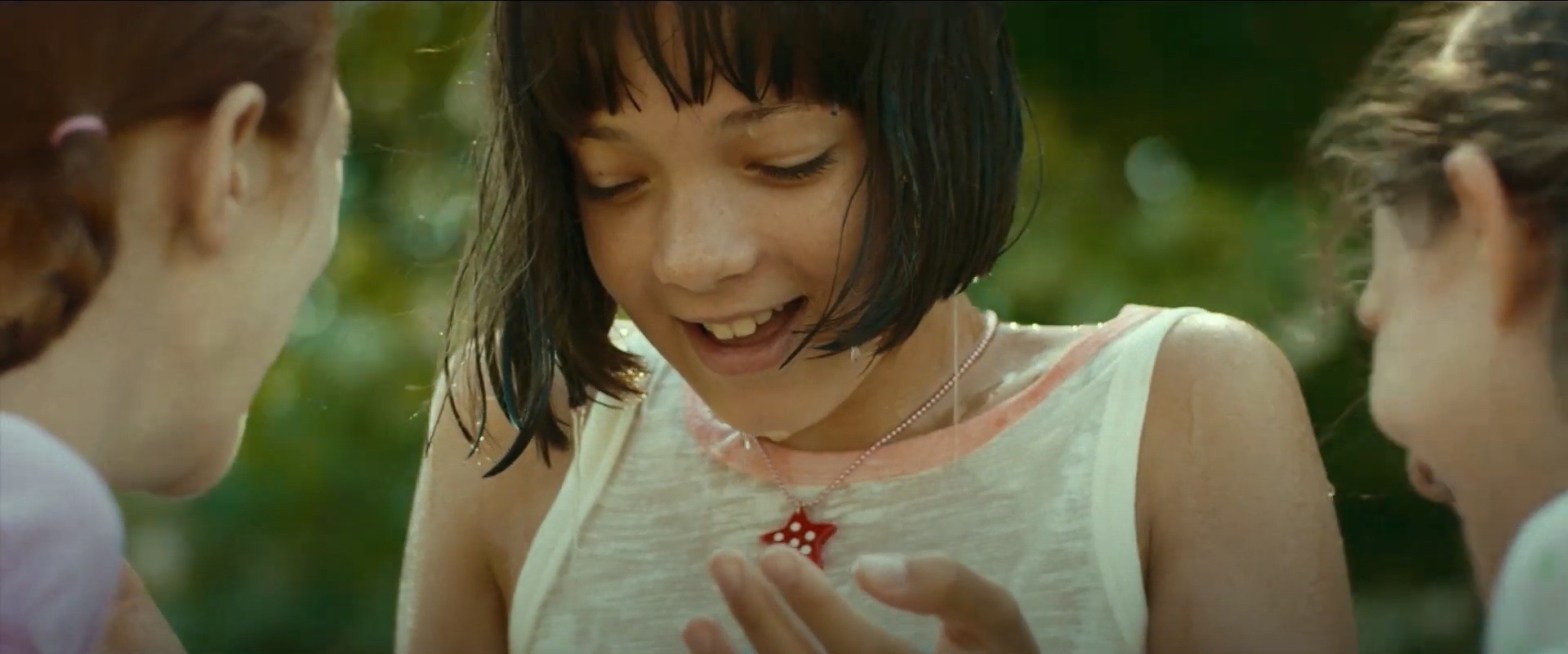
Far leggere la pagella ai propri figli, intrappolati tra scarsa voglia, imbarazzo e terrore, davanti ad amici di famiglia, rappresenta solo uno dei tanti modi per mettere in mostra il raccolto della propria isola, di fronte alle sponde falsamente ammirate dell’altra. I proprietari si scambiano favori di circostanza nel tentativo di impressionarsi a vicenda, nel loro mondo di dentro che si mostra a quello dell’altro, di fuori. 

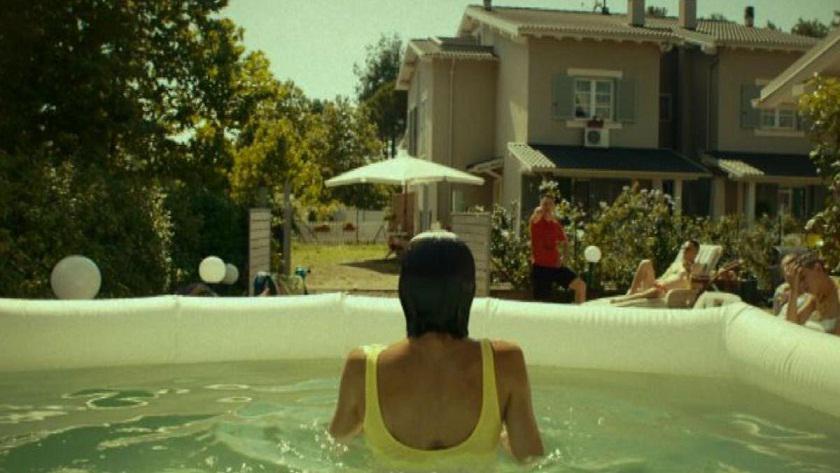
Seconda isola, che contiene la prima e la stringe a sé in una morsa, è Spinaceto, quartiere di Roma a Sud del Grande Raccordo Anulare, a pochi km dall’Eur. Non lontano dal mare di Ostia ma neppure abbastanza vicino. La sua assenza risuona con forza. Se solo si vedesse il mare, oltre quella fila di villette a schiera, forse non tutto ma qualcosa sarebbe diverso. Lo dimostra quella piscina gonfiabile in giardino, che per i bambini rappresenta una gioia e un divertimento immenso mentre per il padre, che sogna in grande, è solamente la prova del suo fallimento. La periferia di Spinaceto non offre ai suoi abitanti nessuna speranza di riscatto. Solamente il maestro delle elementari ha il potere di mostrare un’altra via, di raccontare il mondo in modo diverso. 

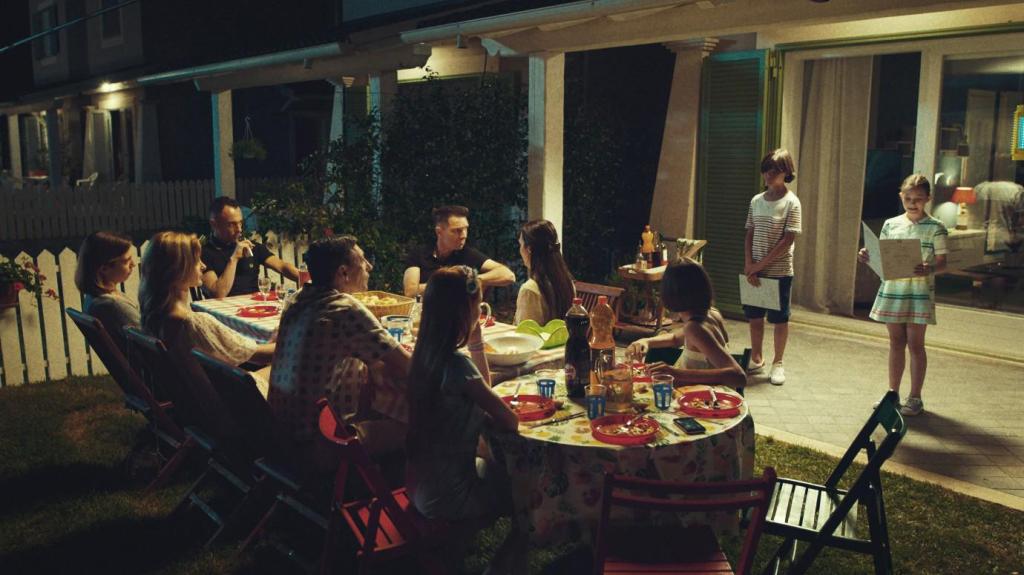
Tutto il film è attraversato dall’ansia dell’interiorità che viene messa in evidenza dai registi come un nucleo-isola. Si noti come viene inquadrata la famiglia di Elio Germano durante la grigliata in giardino. Il tavolo su cui siedono è ripreso in campo lungo da una ventina di metri di distanza. Vediamo la scena in notturna da una distanza notevole, una postazione esterna che sottolinea la violenza che avviene lì dentro, quando persino salvare il figlio dal soffocamento diventa espressione di brutalità. Quando a Dennis va il boccone di traverso, su ansioso sollecito della moglie il padre lo solleva a testa in giù, visibilmente irritato.
Scuotere quel corpicino sembra avergli fatto più male dell’incidente stesso. Né lui né la sorella parlano mai, e la scena è lasciata al padre con le sue grinfie invasive. Si stacca sulla stessa sequenza, e stavolta l’inquadratura remota è dal lato lungo del tavolo, con un cambio che riflette un cedimento del potere finora esercitato: il padre scoppia in un pianto. Dopo essersi inginocchiato davanti alla moglie che lo consola, si rialza e fa tornare il quadro alla ripresa di prima: adesso torna ad essere imperioso e sottrae la carne appena iniziata agli altri tre, seccato perché «neanche una cazzo di grigliata in santa pace si può fare». Il tutto prima che la madre, tacitamente disperata, dica al figlio che non si è ancora ripreso: «Hai visto che hai fatto? Hai fatto piange a papà». Abbiamo appena assistito a un rimbalzo dal potere alla caduta fino alla vendetta, con il passaggio tra due inquadrature e il ritorno alla prima. 

Perché i fratelli non hanno vinto l’Orso alla regia? Altri esempi dell’isola come gabbia si hanno in seguito nel film, e tutti in relazione alle bambine chiuse in macchina: Alessia prima, la neonata di Vilma poi. Davanti a un padre che picchia il fratello o ai genitori che se ne stanno in disparte per i fatti loro, entrambe strillano in macchina, e lo spettatore che sta oltre i vetri alzati sente delle urla appena un’eco soffocata. 

Isola senza mare, Spinaceto si presenta come il rovesciamento de “L’ Isola che non c’è”. A differenza di quella di Peter Pan, questa esiste ma non offre nessuno spazio all’immaginazione. Se ne “L’isola che non c’è” si va per scappare dagli adulti qui non c’è via di fuga possibile. Qui i bambini non riescono neppure  a conquistare la libertà di vivere l’innocenza dei propri anni. Sono subito spinti verso gli aspetti più feroci dell’esistenza. Stupiti e storditi dalla volgarità e dai gesti inattesi degli adulti, trovano insieme l’unico antidoto possibile per trasformare le Favolacce in Favole.

Questo articolo è un esperimento: il risultato di una riflessione comune e l’incontro tra due sguardi diversi, quello di Tommaso Cavani e di Carolina Germini.

En el metro de Paris con Robert Bresson

Parece que algunas líneas del metro de París no han cambiado en cincuenta años. Es como un viaje en el tiempo: ves Pickpocket ves Le diable, probablement y ahí están, las mismas puertas abriéndose antes de tiempo.

Los primeros meses que pasé allí estuve llegando considerablemente tarde a casi todos los lugares. No me acostumbraba a los tiempos ni a los transbordos ni al extraño juego de salidas en algunas estaciones, los pasillos se me hacían interminables y, torpe como soy, acababa perdiéndome o llegando a veces al mismo punto del que había partido.

Como siempre iba con prisas, solía ser el primero del vagón que abría la puerta. En Madrid, si accionas la manivela cuando el tren aún no se ha detenido, la puerta no se abre; la acción sirve de preparatorio, anuncia a los demás la huida: es un acto simple, universal y certero. A veces, cuando la puerta tarda en abrirse más de lo normal, se crea una lucha tácita de varios segundos entre tú, que agitas la manivela compulsivamente desde el coche, y el otro, el que está en el andén, por ver quién da con la sacudida definitiva. 

En París es más fácil: la levantas y se abre, y entonces surge la tentación de saltar. Como llegaba siempre tarde, abría la puerta corriendo y tenía que esperar a que el tren acabase de frenar, porque sabía que, si saltaba, la inercia y mi torpeza me prepararían un desenlace fatal. 

Muchas veces me he preguntado qué convierte a cierto director en un gran cineasta. Ayer volví a ver Le diable, probablement, una de las películas menos aclamadas de Robert Bresson.

La protagoniza un joven suicida, alguien que ha perdido toda la conexión con el mundo y lo considera un lugar ingrato e innecesario —y alude a razones apocalípticas, como la inminente catástrofe ecológica, y existenciales, como el “sentido” de las acciones reales—. Parece una película sobre el fin del mundo, pero es una película sobre el mundo: se ha dicho que es “punk” y “nihilsita”, pero es poética e incluso vitalista.

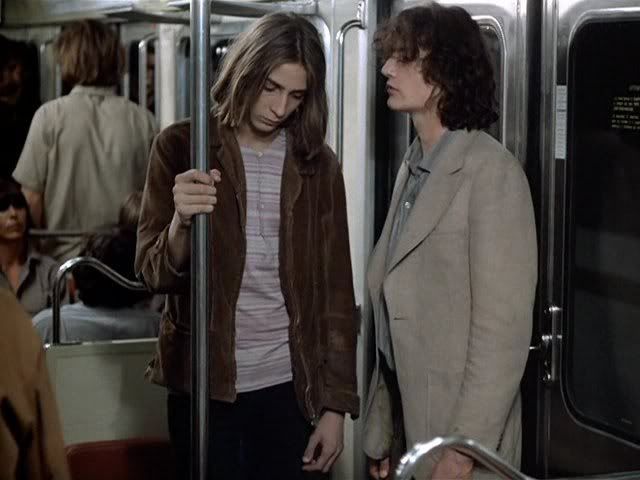
Solo que Bresson, como es un gran cineasta, no subraya sus intenciones. Basta esta escena para comprobar por qué la imagen, la película, niega sin entrometerse el comportamiento de su protagonista: es el último viaje en metro de Charles, lleva en su bolsillo una pistola y un fajo de billetes que le dará a su verdugo, un amigo suyo con quien ha acordado el “suicidio” porque él no se atreve a hacerlo solo. Parece una secuencia normal, pero el titubeo del compañero descubre la esencia de la película: no sabemos si se mueve él o lo mueve el metro, si se acerca resignado a la puerta o si se está dejando llevar, es decir: no sabemos si se mueve él o lo mueve el mundo. Es cine, no literatura: no podemos entrar en su mente. Aunque abren el tren en marcha, no saltan (me recuerda a Roquentin: «Sé que nunca más volveré a saltar»); aunque no lo parezca, no tienen prisa.

Pablo Caldera